Concreting guide
Why does new concrete crack, and should you be worried when it does?
New Concrete Almost Always Cracks. Here's Why That's Often Fine.
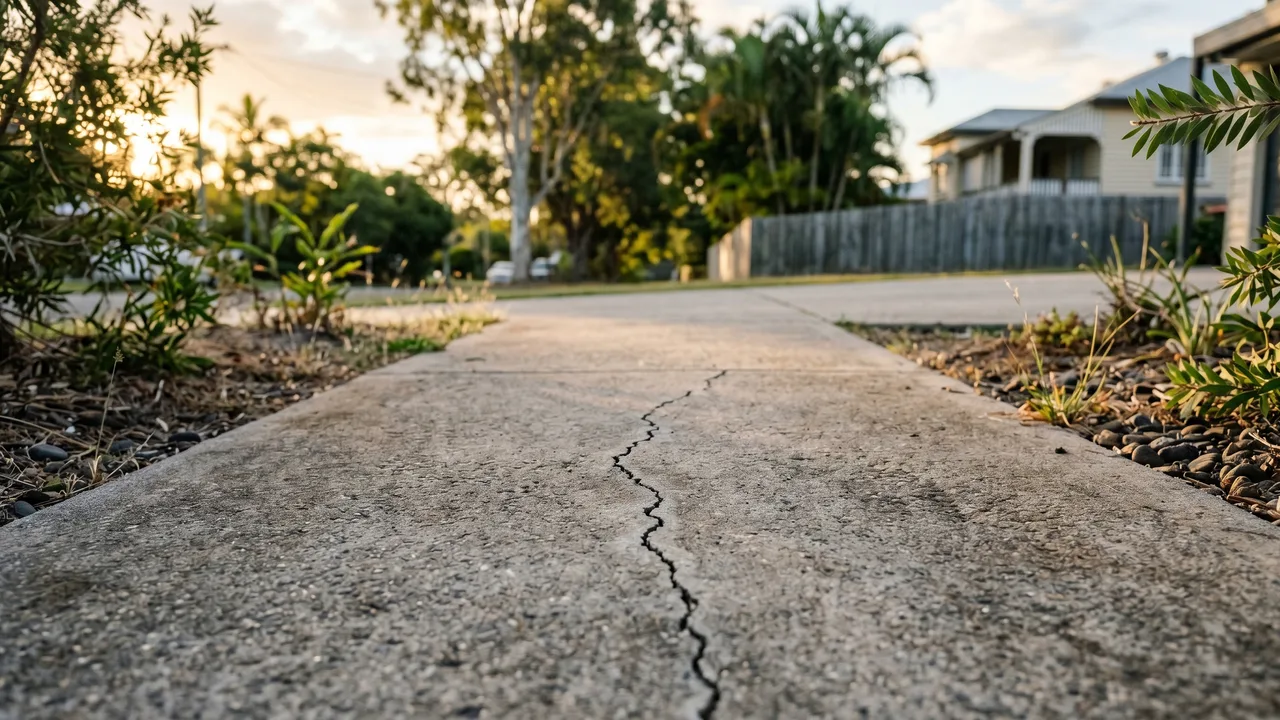
New concrete cracks. It's not a sign of poor workmanship, a bad mix, or a dodgy contractor. It's a near-universal property of the material. The real question isn't whether your slab will crack, but whether the cracks that appear are normal shrinkage cracks or something that needs attention.
Why Concrete Cracks in the First Place
Concrete starts as a wet, workable mix of cement, aggregate, sand, and water. As it cures, that water evaporates and the chemical hydration process kicks off. The slab shrinks slightly as it does. That shrinkage creates tensile stress inside the concrete, and concrete is strong in compression but weak in tension. When the tensile stress exceeds the concrete's strength at a given point, it cracks.

This is called plastic shrinkage cracking when it happens in the first few hours, and drying shrinkage cracking when it develops over the first weeks and months. Both are predictable. Both happen even with a correctly mixed, correctly placed slab.
On top of shrinkage, concrete also expands and contracts with temperature changes. Brisbane's climate makes this more pronounced than in cooler cities. A slab poured in summer on a Cannon Hill driveway can experience significant temperature swings between morning and afternoon, and between seasons. That thermal movement adds stress to the concrete over time.
The Role of Control Joints (and Why They Matter So Much)
A good concreter doesn't try to prevent cracking. They try to control where it happens. That's the job of control joints, also called expansion joints or saw cuts, depending on the type.
Control joints are deliberate weak points cut or formed into the slab at regular intervals. When the concrete wants to crack, it cracks along the joint, which is hidden beneath the surface or made part of the design. You see a straight, intentional line rather than a jagged random crack running across your new driveway.
As a rule of thumb, control joints should be placed at intervals roughly 24 to 30 times the slab thickness. For a standard 100mm residential slab, that's a joint every 2.4 to 3 metres. On larger pours like an alfresco pad or a shed slab, skipping or spacing joints too far apart is one of the most common reasons homeowners end up with visible cracks through the centre of the concrete.
We cut control joints on all our residential pours. It's not optional.
What Normal Shrinkage Cracks Look Like
Hairline shrinkage cracks are typically:

- Less than 0.3mm wide (roughly the thickness of a credit card edge)
- Shallow, not running through the full depth of the slab
- Random in pattern, or running between control joints if the joint spacing was slightly too wide
- Stable, meaning they don't grow over weeks and months
These cracks don't compromise the structural integrity of a driveway, pathway, or entertainment slab. They won't let water pool or penetrate in any meaningful way on a well-finished slab. They're cosmetically imperfect, but they're not a defect.
In Brisbane's Inner East, particularly in suburbs like Norman Park, Hawthorne, and Balmoral where block sizes tend to be larger and older homes are being renovated regularly, we see hairline cracking appear within the first two to eight weeks on most new pours. It's consistent with what the material does in this climate.
When Cracks Are Actually Cause for Concern
Not every crack is a shrug-and-move-on situation. There are signs that something more serious is going on.
Width matters. A crack wider than about 3mm deserves a closer look. At that width, water can enter, debris can fill the gap, and in a reinforced slab the reo (reinforcing steel) may eventually be exposed to moisture and corrode.
Displacement matters more. If one side of the crack is higher or lower than the other, the slab has moved differentially. This is called a step crack, and it usually points to a subgrade issue, meaning the ground beneath the slab has settled, washed out, or was poorly compacted before the pour. In parts of Murarrie and Tingalpa, which sit on lower-lying ground with heavier clay soils, subgrade preparation is especially important before any slab work.
Pattern cracking (map cracking) can indicate a mix problem. A network of fine cracks resembling a mosaic across the surface, sometimes called crazing, can point to over-finishing the surface while bleed water was still rising, or to a mix with too high a water-to-cement ratio. This weakens the surface layer and can lead to dusting or spalling over time.
Cracks that grow or move are a red flag. A stable hairline crack from year one that remains a hairline crack in year five is benign. A crack that's widening, lengthening, or showing seasonal movement warrants investigation.
Brisbane-Specific Factors That Influence Cracking
Brisbane's subtropical climate creates conditions that test concrete more than many people realise.
Heat and evaporation. On a hot, dry, windy Brisbane day, surface moisture can evaporate faster than the bleed water rising from the mix can replace it. This creates early plastic shrinkage cracking. Experienced concreters adjust their schedule accordingly, avoid pouring in the hottest part of the day in summer, and use evaporation retarders or shade where practical.
Clay subgrades. Much of Brisbane's Inner East sits on reactive clay. Clay shrinks when dry and expands when wet. A slab poured over poorly prepared clay is working against a subgrade that moves with rainfall and dry spells. Proper compaction, and sometimes a gravel or road base sub-layer, makes a real difference to long-term slab performance.
Tree roots. If you live in Hawthorne or Morningside and you have a mature poinciana, jacaranda, or fig anywhere near your proposed slab, root encroachment is worth considering seriously. Tree roots grow toward moisture and can lift or fracture a slab from underneath within a few years. This isn't specific to bad concrete. It's a site condition that needs to be managed at the design stage.
What You Can Do About Existing Cracks
If your new slab has developed hairline cracks and you're past the initial curing period (typically 28 days for full strength), here's a practical way to think about it.
Leave hairline cracks alone. Filling hairline cracks with flexible sealant often looks worse than the crack itself and doesn't address any underlying issue. In a functional slab, they're cosmetic.
Fill wider cracks with a flexible polyurethane or epoxy filler. For cracks in the 1 to 3mm range on a driveway or path, a flexible crack filler keeps debris out and slows water ingress. This is a maintenance task, not a structural repair.
For step cracks or cracks over 3mm, get a second opinion. A structural or geotechnical assessment may be warranted if there's any sign of subgrade movement. The cost of that assessment is far cheaper than re-pouring a slab, and it tells you whether the problem will recur if you simply patch and move on.
Re-pour vs. repair. If the slab is structurally compromised, a patch is rarely a long-term solution. On a job in the $1,500 to $15,000 range, a full replacement with proper subgrade preparation is usually better value over ten years than repeated patching of a fundamentally unstable slab.
A Practical Closing Thought
Most homeowners who call us about cracking concrete are relieved to hear that what they're looking at is normal. Hairline shrinkage cracking in the first few months is part of what concrete does, especially through a Brisbane summer. Good workmanship doesn't eliminate cracking; it controls it.
What separates a well-done job from a problematic one is the subgrade preparation, the joint placement, the mix design, the curing method, and the site conditions. If you're looking at a new crack and you're genuinely unsure, measure it, photograph it, and watch it over a few weeks. A crack that stays stable and narrow is almost certainly benign. A crack that grows, steps, or maps out across the surface is worth a conversation with whoever poured the slab.
If you're in Morningside, Bulimba, Cannon Hill, or anywhere across Brisbane's Inner East and you want a straight answer about a crack on your property, we're happy to take a look without a sales pitch attached.
Quick answers