Concreting guide
What makes a concrete pool surround safe and which finishes actually work?
What Makes a Concrete Pool Surround Safe, and Which Finishes Actually Work?
A safe pool surround does two things well: it gives your feet grip when wet, and it drains water away from the pool edge so puddles don't form. The finish you choose determines both, and some popular-looking options fail at one or both when tested by a Queensland summer.
Here's what you need to know before you pour.
Why Slip Resistance Is More Complicated Than It Sounds
Most people assume "rough equals safe". That's true up to a point, but texture alone doesn't guarantee grip. Pool surrounds deal with a specific combination of hazards: bare feet, sunscreen residue, wet leaves, algae growth in shaded corners, and water that pools if the fall isn't right.

Australian Standard AS 4586 classifies surface slip resistance using a wet pendulum test and a ramp test. For a pool surround, you're generally looking for a Class W rating or better when tested wet. Some finishes look grippy and feel grippy dry, but drop to an unsafe rating once sunscreen and water are combined.
The other thing to understand is that slip resistance changes over time. A freshly broom-finished slab has decent grip. After three years of foot traffic, UV exposure and chemical splash from pool water, that surface can smooth out. Planning for maintenance from the start saves money later.
The Finishes That Actually Work in Brisbane Backyards
Broom Finish
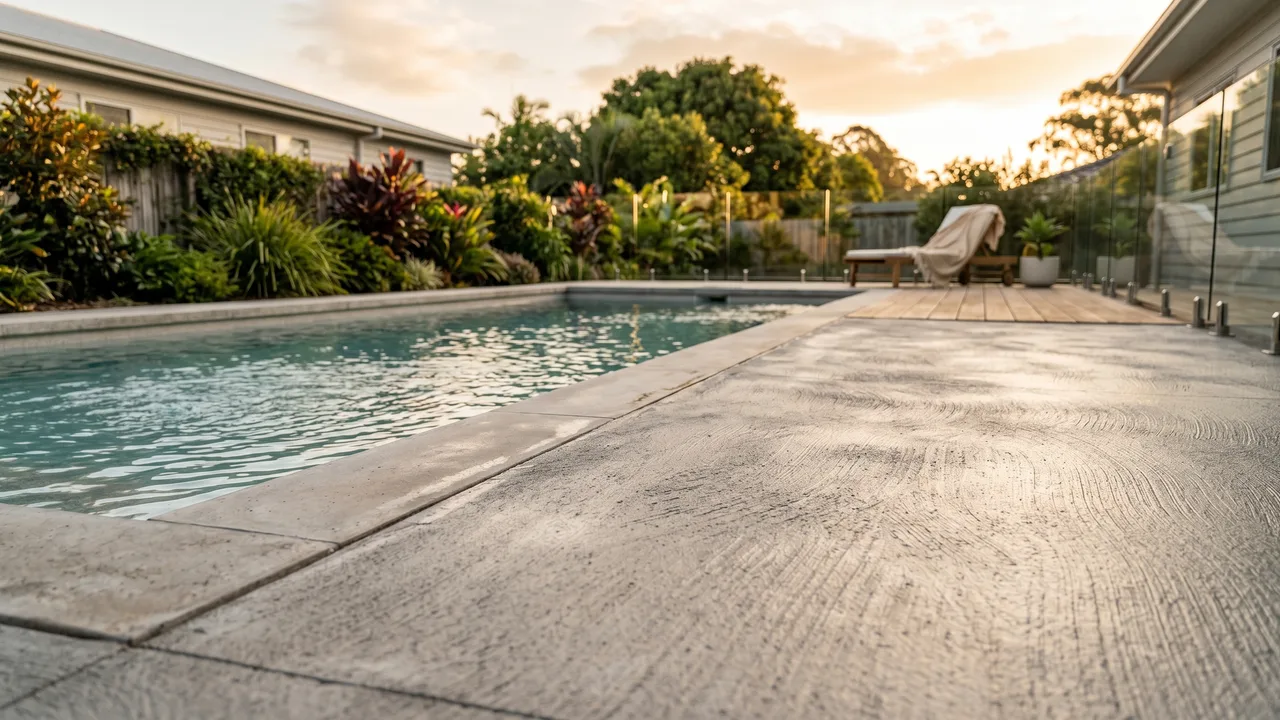
This is the most common and most affordable option. After the pour, a broom is dragged across the wet concrete to leave parallel ridges. Done well, it gives a consistent Class W-rated surface and holds up reliably in sun-exposed areas.
The trade-off is aesthetics. Broom finish is utilitarian. For a Hawthorne or Balmoral backyard where you've spent serious money on landscaping and a quality pool, it can look underdressed. It's also prone to showing staining from leaves, particularly jacaranda in spring, which is a reality for much of the Inner East.
Broom finish is typically the lowest cost option, which makes it a sensible choice for functional areas behind a pool fence or on a back service path, rather than the feature entertaining zone.
Exposed Aggregate
Exposed aggregate is the workhorse of pool surrounds in Brisbane. The top layer of cement paste is washed or brushed away while the concrete is still green, leaving the stone aggregate visible and proud. The result is a consistently textured surface that maintains grip even when wet and contaminated.
It looks good alongside most pool designs, holds its appearance well in Queensland sun, and doesn't require sealing to maintain safety (though sealing can be done for colour enhancement). The aggregate choice matters: rounder, polished stones give less grip than angular aggregates. When you're discussing a job with us, we'll talk through aggregate size and shape relative to how the surround will actually be used.
Cost is mid-range, typically more than broom finish but less than high-end reconstituted stone or pavers. For most Morningside, Cannon Hill and Murarrie backyards, it hits the right balance.
Honed Concrete
Honed finish involves grinding the cured surface back to reveal a smoother, matte appearance with fine aggregate visible. It looks clean and contemporary, which is why it's popular in architect-designed pools in Bulimba and Hawthorne.
Here's the honest trade-off: honed concrete is smoother than exposed aggregate, and that smoothness costs you some slip resistance. To bring it back to a safe rating, a penetrating sealer with a grip additive or a fine anti-slip broadcast is typically applied. That works well initially, but the sealer needs to be reapplied every one to three years depending on foot traffic and chemical exposure. If maintenance gets skipped, you can end up with a surface that looks beautiful and performs poorly.
Honed concrete also shows water marks and chemical splash more clearly than textured surfaces. If your pool uses saltwater chlorination (common in Inner East Brisbane), that residue can streak a honed surface and require more frequent cleaning.
Spray-On and Acrylic Coatings Over Concrete
This is worth addressing because it comes up often. Spray-on texture coatings applied over a base concrete slab can look good and initially perform well. Some are specifically rated for pool surrounds.
The problem is long-term adhesion. Brisbane's humidity, UV load and the freeze-thaw-free but wet-dry cycling of a Queensland yard mean that coatings can begin to delaminate within five to ten years. When they peel, the surface becomes uneven and can be more dangerous than an uncoated slab. It also looks poor. If you go this route, use a product specifically designed for pool surround use and factor in the likelihood of recoating within a decade.
Getting the Drainage Fall Right
No matter which finish you choose, the fall of the slab is critical. Concreters work to a minimum fall away from the pool coping and toward drainage channels or the garden edge. In most Brisbane installations, that's around 1:80 to 1:50 (roughly 12-20mm drop per metre of run).

Get the fall wrong and water sits on the surface. Standing water accelerates algae growth on any finish, quickly turning a compliant surface into a slip hazard. It also creates a wetter environment at the pool edge where most slips and falls actually happen.
On sloped Inner East blocks, like those common in Norman Park and Balmoral, getting the drainage fall right requires more planning, sometimes a channel drain or a stepped design. It adds complexity but it's not negotiable from a safety standpoint.
Edging, Coping and Where Most Injuries Actually Happen
Pool-edge injuries typically happen at the transition between the pool coping and the surround, or between the surround and a step. These are the points where people push off, pivot, or step down while wet.
Coping units (the cap pieces along the pool edge) are usually supplied by the pool builder rather than the concreter. But the surround should meet the coping cleanly with no lips or level changes that could catch a foot. We pour the surround to butt up against the coping without creating a trip edge.
Steps and level changes within the surround area should have a contrasting band at the nosing edge, both for visibility and for grip. This is especially important if your pool area is used at night, which most Brisbane entertaining spaces are.
Costs and What Affects Them
Pool surrounds in Brisbane typically range from around $80 to $180 per square metre poured and finished, depending on the finish type, site access, shape complexity and the existing substrate. A straightforward rectangular surround on an accessible flat block at the lower end; a shaped surround with steps, drainage channels and exposed aggregate on a sloped block at the higher end.
Our jobs in the Inner East generally fall between $1,500 for a small surround top-up or repair and $10,000-plus for a full surround around a decent-sized in-ground pool with entertaining areas connected. If you're combining the pool surround with an alfresco slab, there's usually an efficiency gain because we're already mobilised and setting up formwork on the same visit.
Choosing the Right Finish for Your Situation
Exposed aggregate is the most consistently safe and low-maintenance choice for Brisbane pool surrounds. That's not a sales position, it's what performs reliably over time without demanding a maintenance schedule most people won't keep.
Honed concrete is a reasonable choice if you're committed to resealing every couple of years and want a specific aesthetic. Broom finish works for functional secondary areas. Avoid thin coatings over old concrete unless you're prepared to redo them within a decade.
Beyond finish, the most important decisions are drainage fall and edge treatment. Get those right at the time of pour, because fixing them later is expensive.
If you're planning a pool surround in Morningside, Norman Park, Hawthorne, Bulimba, Balmoral, Cannon Hill, Murarrie or Tingalpa and want a straight answer on what will work for your specific backyard, give us a call. We're local, we know the blocks in this area, and we'll tell you what we'd do on our own place.
Quick answers