Concreting guide
Does slab thickness really matter for a backyard shed or garage in Brisbane?
Yes, slab thickness matters — but probably not in the way you'd expect. The difference between a slab that lasts 30 years and one that cracks within five often comes down to a handful of centimetres, and those centimetres have a real cost attached to them. Here's what you actually need to know before you pour concrete in a Brisbane backyard.
What the minimum standards actually say
In Queensland, a basic unreinforced concrete slab typically starts at 75 mm for garden-level foot traffic areas. For a shed or garage slab, though, 75 mm is generally not enough. The practical industry starting point for a residential garage slab is 100 mm, and that assumes decent subgrade preparation underneath.
The Australian Standard for residential slabs and footings (AS 2870) sets out soil classification requirements that influence slab design. Brisbane's Inner East suburbs — Morningside, Norman Park, Hawthorne, Bulimba, Balmoral and surrounding areas — sit across a mix of soil types, including reactive clay. Reactive clay expands when wet and contracts when dry, which puts seasonal stress on any concrete structure sitting on top of it. That matters more here than in many other parts of Australia, and it's a key reason why the "minimum" is rarely the right answer for this part of Brisbane.
Local council requirements can also impose their own conditions depending on whether you're building a Class 10a structure (a shed or non-habitable garage) and whether you need an approval. Always check with Brisbane City Council before you pour; some structures under 10 square metres on ground level don't require a building approval, but most double garages and larger sheds do.
The difference between 100 mm and 125 mm (and when it matters)
For a small backyard shed storing garden tools and a mower, 100 mm of reinforced concrete with a decent mesh or reo configuration is typically sufficient. You are not driving anything heavy over it. The loads are predictable and light.

A single-car garage changes the picture slightly. A standard passenger vehicle weighs roughly 1,500 to 2,000 kg. Parked on a well-prepared 100 mm slab with proper reo, that's fine. Where people run into trouble is when a heavier ute, a trailer, or a small campervan enters the equation. A loaded 3.5-tonne vehicle is a different proposition entirely.
Moving to 125 mm adds meaningful structural depth for relatively modest extra cost. On a 6 x 6 m slab, the additional concrete volume is around 0.9 cubic metres. At current Brisbane pricing, that typically adds $200 to $400 to a job. For a slab you hope to use for 20 or 30 years, that is not a large number.
A 150 mm slab is appropriate when you are parking heavier vehicles, running a home workshop with a vehicle hoist, or working with machinery (a ride-on mower stored on a ramp, a small tractor). It is also worth considering in areas with known subgrade variability — if the previous owner of a Hawthorne or Cannon Hill block did any fill work in the back yard, or if there is soft fill from an old garden bed, you want more slab depth to compensate.
Reinforcement matters as much as thickness
Thickness alone does not make a slab strong. The reinforcement inside it does most of the heavy lifting under load. A 125 mm slab with properly lapped SL72 mesh (or better, SL82 for larger spans) will outperform a 150 mm slab with inadequate or poorly positioned reo.
Two common mistakes in residential pours:
- Reo placed too low. Mesh sitting on the dirt, or barely lifted, ends up in the tension zone but does little structural work. Proper bar chairs or reo stools lift the mesh to the correct depth within the slab.
- Mesh laps too short. Mesh sheets need to overlap by at least one full square (typically 200 to 225 mm) to transfer load effectively. Rushed pours sometimes cut this short.
For a workshop slab where you expect concentrated point loads (a vehicle hoist, a jack stand, a heavy workbench bolted to the floor), some concreters will specify deformed bar (reo bar) in addition to or instead of mesh. This is worth discussing when you get quotes. It adds cost but improves performance at specific stress points.
Subgrade preparation: the part you can't see after the pour
Here is the honest truth about slab failures in Brisbane's Inner East: most cracking is not caused by the wrong slab thickness. It is caused by poor preparation of the ground underneath.

A well-compacted, uniform subgrade — typically 100 mm of compacted roadbase or crushed rock — gives the slab consistent support across its full area. Without that, you get differential settlement. One corner of the slab finds soft ground and drops slightly. The slab tries to span the gap. It cracks.
On older Morningside and Tingalpa blocks, you might have tree roots, old garden waste, uncompacted fill, or soft spots from previous structures. Any of these can cause problems under a slab regardless of how thick you pour it. The solution is proper site investigation, excavation of problem material, and compaction of replacement subgrade before the form work even goes in.
If you are on a sloped block (common in Balmoral and Hawthorne), a retaining wall or cut-and-fill might precede the slab pour. The footing work for that retaining wall needs to be right before anything else proceeds; a slab poured against a poorly footed retaining wall will move when the wall moves.
Cost versus benefit: a practical comparison
Let's put some rough Brisbane numbers to this so the trade-offs are clear. These are indicative ranges for the Inner East suburbs and will vary with site conditions, access, and finishes.
| Slab type | Thickness | Approx. cost (6 x 6 m) |
|---|---|---|
| Basic shed slab, mesh reo | 100 mm | $2,000 - $3,500 |
| Single garage, mesh reo | 100-125 mm | $3,000 - $5,000 |
| Double garage, mesh reo | 100-125 mm | $4,500 - $8,000 |
| Workshop/heavy use | 125-150 mm + reo bar | $6,000 - $10,000+ |
These figures include subgrade preparation, form work, pour, and a standard broom finish. Exposed aggregate or coloured concrete adds cost. Difficult access (rear Cannon Hill block with a narrow side gate, for example) also adds cost because concrete may need to be pumped rather than chuted from the truck.
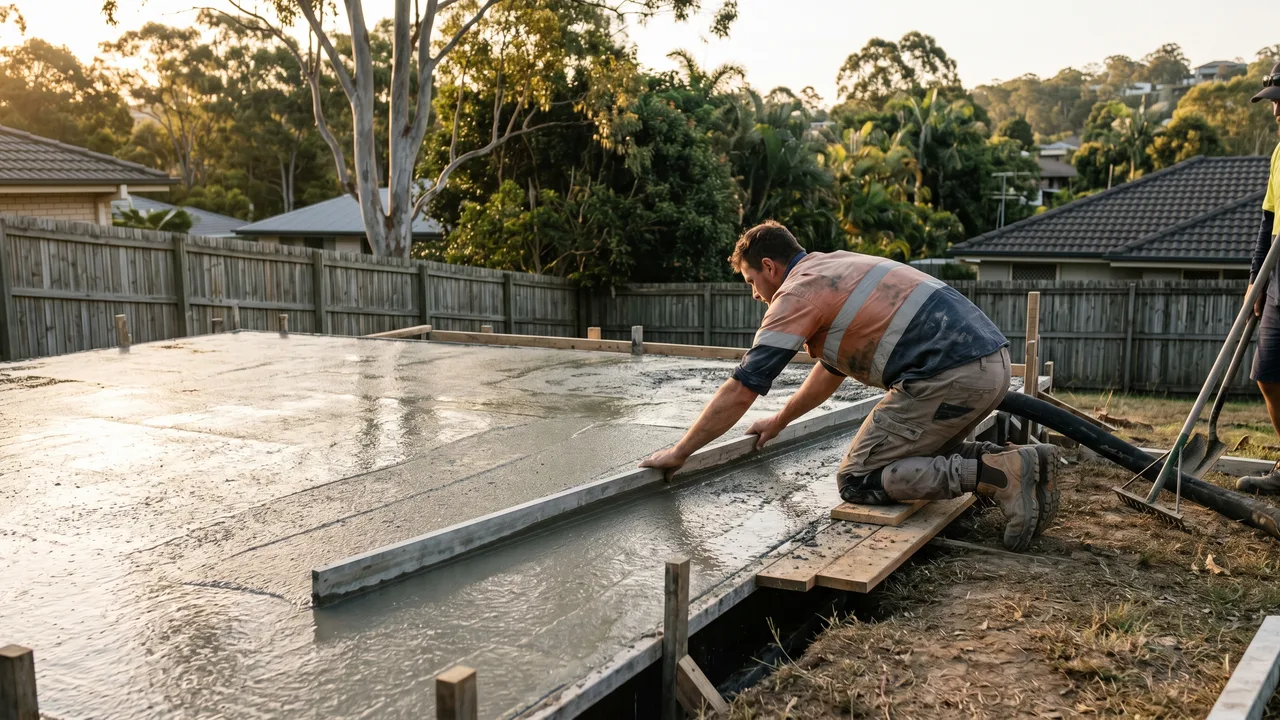
The DIY versus professional question comes up here. In Queensland, laying your own slab is not illegal for a Class 10a structure in many cases. But getting the reo positioned correctly, the concrete placed and screeded before it goes off, and the surface finished properly is genuinely hard work with a narrow time window. A botched pour is expensive to fix. For most homeowners, the professional cost is the better investment.
Our recommendation if you are planning a shed or garage slab
Do not default to the minimum. For most residential garages in the Morningside area and surrounding suburbs, we recommend starting at 100 to 125 mm with SL82 mesh on proper bar chairs, over a compacted roadbase subgrade. If you are parking anything heavier than a standard passenger vehicle, or running a workshop, move to 125 to 150 mm and talk about reo bar for point load areas.
Spend some of your budget on site preparation. It is not glamorous, and you cannot see it once the slab is poured, but it is the most reliable way to avoid cracking over time.
When you are getting quotes, ask specifically what subgrade preparation is included, what mesh specification is being used, and where the reo will be positioned within the slab. A concreter who can answer those questions clearly and specifically is generally one worth trusting.
If you are in Morningside, Norman Park, Hawthorne, Bulimba, Balmoral, Cannon Hill, Murarrie, or Tingalpa and want a straightforward conversation about what your site actually needs, we are happy to come out, look at the ground conditions, and give you a written quote with the spec spelled out. No obligation, and no surprises buried in the fine print.
Quick answers