Concreting guide
Can you pour a concrete slab yourself, or is it a job for a professional in Brisbane?
Can You Pour a Concrete Slab Yourself, or Is It a Job for a Professional in Brisbane?
The honest answer is: it depends on the size and purpose of the slab. A small garden path or a modest shed base is something a capable, patient DIYer can tackle. A driveway, pool surround or entertainment area on a sloped Inner East Brisbane block is a different matter entirely, and getting it wrong is expensive to fix.
Here's a clear-eyed look at what's actually involved, so you can make a call that suits your budget, your skills and your block.
What Concrete Work Actually Involves (More Than Most People Expect)
Pouring concrete sounds straightforward. Mix, pour, level, done. In practice, there are about a dozen decisions and physical steps before the truck even reverses down your driveway.

You need to:
- Strip and compact the base to the right depth (typically 100mm for a slab, more for driveways or heavy loads)
- Set up and secure formwork to hold the wet concrete in shape
- Lay reinforcing mesh or reo bar at the correct height within the slab
- Order the right concrete mix (strength is measured in MPa; residential slabs are typically 20MPa or 25MPa, driveways often 25MPa or higher)
- Coordinate the concrete truck delivery and pour everything within the working window before the mix starts to set
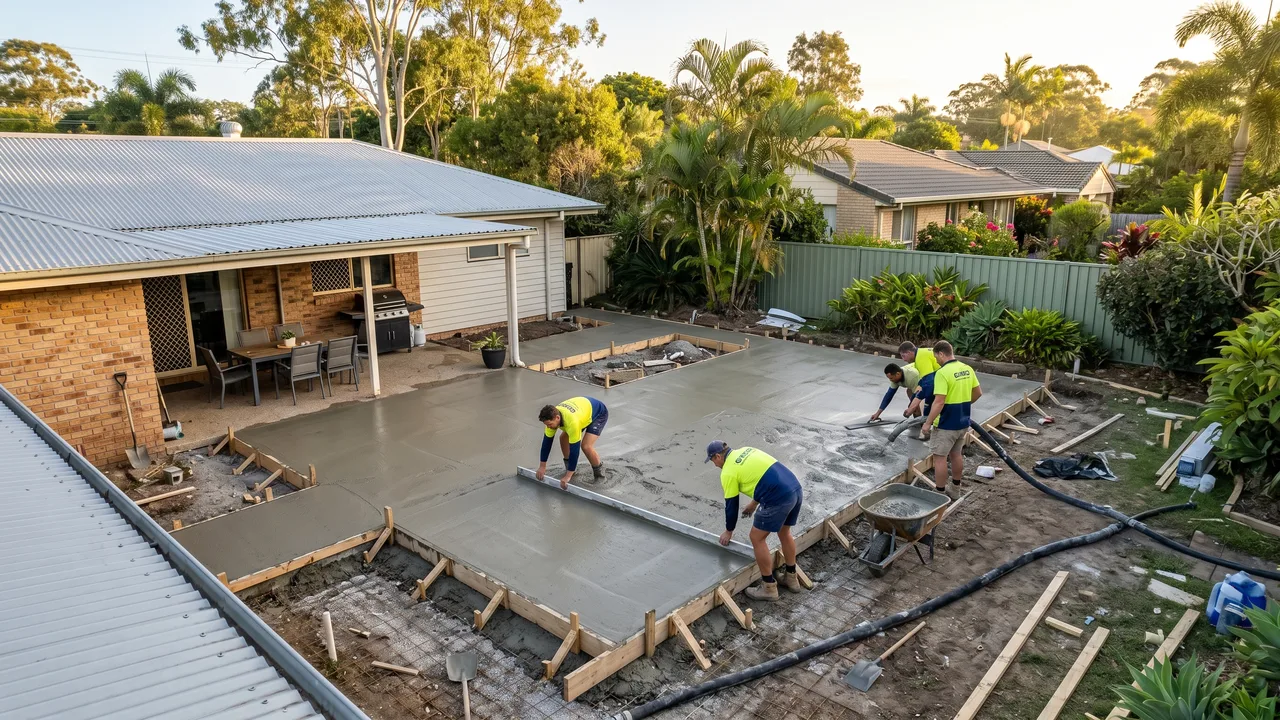
- Screed and finish the surface evenly, then cure it properly over several days
Miss a step, rush a step, or hit a problem mid-pour with no backup plan and you can end up with a slab that cracks early, drains poorly, or fails to meet council requirements if a permit is needed.
Where Brisbane's Inner East Adds Its Own Complications
Morningside, Norman Park, Hawthorne, Balmoral and the surrounding suburbs sit on some genuinely tricky ground. Many blocks slope, some steeply. Older lots in Bulimba and Hawthorne often have clay-heavy subsoils that move seasonally, which makes proper compaction and sometimes a thicker slab or extra reinforcing more important than it would be on a flat sandy site.
Queenslander homes on stumps present access challenges too. Getting a concrete truck (or even a pump truck) close enough to pour on a tight inner-city lot can require careful planning. In our experience working across these suburbs, a significant number of jobs need a concrete pump rather than a direct chute pour, and pump hire adds to the cost.
There's also Queensland's climate to factor in. Pouring concrete in high summer heat, especially during humidity spikes, shortens your working time considerably. Concrete can skin over faster than expected. Experienced concreters adjust water ratios and work pace accordingly; a first-time DIYer often doesn't get that memo until the surface starts to go off unevenly.
The Real Cost Comparison: DIY vs Professional
Let's look at a typical mid-sized job: a 6x6 metre (36 square metre) backyard slab for an entertainment area.

DIY rough costs:
- Concrete supply (approx. 1.5 cubic metres at ~$300-$350/m³): $450-$525
- Reinforcing mesh: $120-$180
- Formwork timber and stakes: $80-$150
- Tool hire (plate compactor, screed, float): $150-$250
- Pump hire if needed: $400-$700
- Skip bin or rubble removal if excavating: $250-$400
- Your time: two full weekends minimum, realistically
Total materials and hire: roughly $1,450-$2,200, before any mistakes.
Professional quote for the same job: typically $2,500-$4,500 in Brisbane's Inner East, depending on access, finish and ground conditions.
The gap is real but narrower than most people assume once you add up all the incidentals. And a professional result carries workmanship you can rely on, a finished surface you're proud of, and no anxiety about whether the base is compacted correctly under the slab you can't see.
For very small jobs, say a 10-12 square metre garden path with no slope and easy access, DIY can make genuine financial sense. For anything load-bearing, anything that needs to drain correctly, or anything on a sloped block, the calculus shifts toward professional work fairly quickly.
When You Should Definitely Call a Professional
Some situations genuinely aren't suitable for DIY, regardless of your skill level:
Driveways. A driveway needs to bear vehicle loads repeatedly over years. Thickness, mix strength, reinforcing and the base compaction all matter more than they do for a garden path. A driveway that fails means breaking it up and starting over. That's not a cheap lesson.
Sloped blocks needing footings. Plenty of homes across Balmoral, Cannon Hill and Tingalpa have retaining walls or are planning them. The concrete footings that underpin those walls need to be done correctly or the wall can fail over time, sometimes taking fencing or garden structures with it.
Pool surrounds. The area around a pool needs a non-slip finish and it needs to drain away from the pool shell, not toward it. It also lives in a wet environment year-round. Getting the surface finish wrong or the fall wrong creates a slipping hazard and long-term water problems.
Any job needing council approval. Some concrete work in Brisbane, particularly driveways crossing a kerb or altering stormwater drainage, may require a Brisbane City Council permit or notification. A professional working locally will know the threshold. A DIYer often doesn't find out until an inspector flags it.
What a Professional Concreter Does Differently
It's not just the labour. An experienced concreter brings:
- Subbase assessment. They look at what's underneath and adjust depth and reinforcing accordingly, rather than assuming a standard approach will work everywhere.
- Correct mix ordering. They know which mix suits which application and order accordingly from the batching plant, often with admixtures for workability or set time in hot weather.
- Efficient pour management. A crew that has poured hundreds of slabs works quickly and in a coordinated sequence. Concrete doesn't wait while you figure out the next step.
- Surface finishing. Achieving a broom finish, exposed aggregate or a smooth trowelled finish to a consistent standard takes practice. It's one of the most visible things about a concrete job and it's harder than it looks.
Our Honest Recommendation
If you're handy, physically capable and looking at a small, flat, non-load-bearing slab with easy access, a DIY approach can work. Go in with a solid plan, hire the right equipment and don't rush the base preparation.
For anything larger, anything on a slope, anything that vehicles will use, or anything where drainage matters, bring in a professional. The cost difference over the life of a well-poured slab is very small. The cost of a failed slab, which typically means full removal and repour, is not.
We cover Morningside, Norman Park, Hawthorne, Bulimba, Balmoral, Cannon Hill, Murarrie and Tingalpa. If you're weighing up a project and want a straightforward quote with no pressure, we're happy to come and look at the site and tell you honestly what's involved. Sometimes a site visit changes the picture entirely, in either direction.
Quick answers