Concreting guide
Poor drainage will ruin a concrete slab. What Inner East homeowners need to know before they pour.
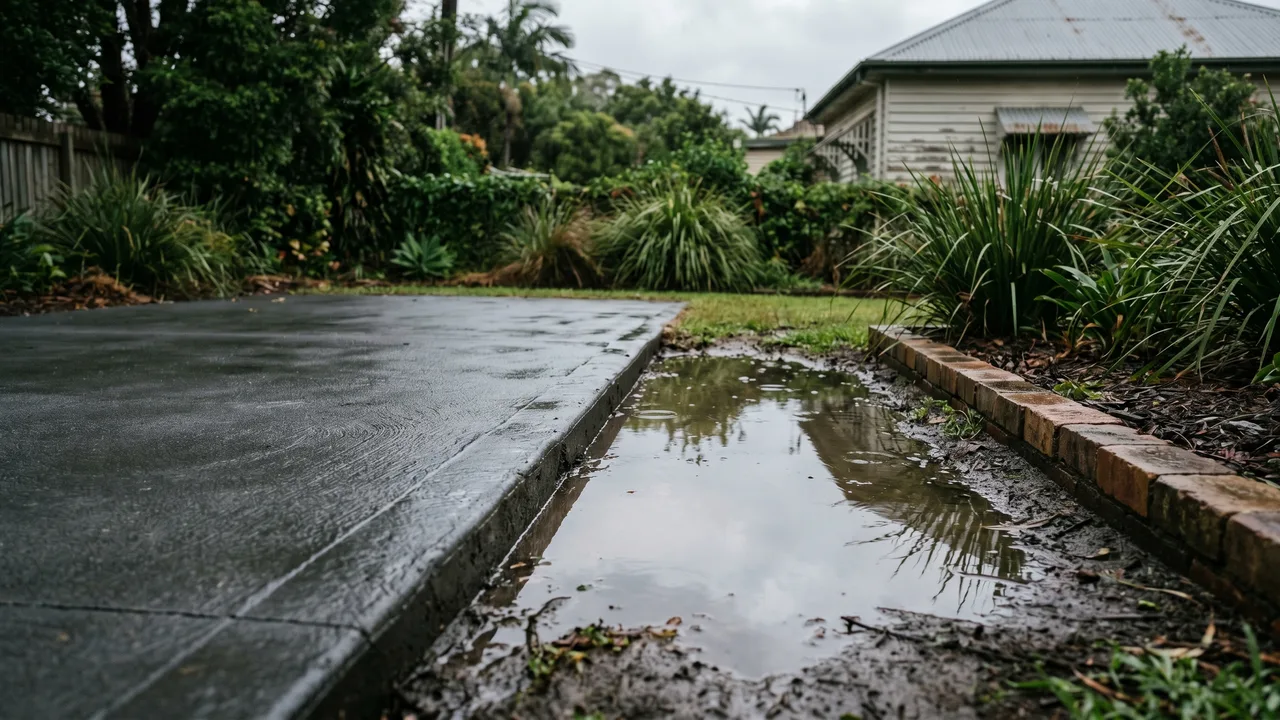
Poor drainage doesn't just inconvenience you — it actively destroys concrete. Water sitting beneath or against a slab causes the sub-base to shift, undermines reinforcement, and opens the door to cracking within a few wet seasons. If you're planning a pour anywhere in the Inner East, getting drainage right before the first truck arrives is the single most important thing you can do.
Why water and concrete slabs don't mix
Concrete itself isn't especially vulnerable to water once it's cured. The problem is what water does to everything underneath and around it.
When rainwater can't escape, it saturates the compacted sub-base. Saturated soil loses its load-bearing capacity. The slab above it — whether it's a driveway, a garage floor or an alfresco pad — no longer has uniform support. Some spots settle, others stay put. That differential movement is what cracks a slab.
There's also a slower process at work. Repeated wet-dry cycles cause fine soils to expand and contract. In the Inner East, those clay-heavy soils that show up in Balmoral, Norman Park and parts of Hawthorne are particularly prone to this. A slab poured straight onto poorly drained clay without adequate bedding and drainage design is borrowing trouble.
Then there's hydrostatic pressure. In low-lying spots — and there are plenty of those in Murarrie and the flatter sections of Cannon Hill — water can build up beneath a slab and physically push upward. Over time, this heaves the concrete or forces moisture through any cracks that do form.
What makes Inner East drainage different
Brisbane's Inner East has its own set of drainage challenges that aren't always obvious until you've worked in the area for a while.

Block topography. A lot of Inner East blocks aren't flat. Bulimba, Balmoral and Norman Park are hilly enough that water naturally runs fast across yards. Without deliberate drainage paths, that water finds its way to the lowest point — often a slab edge or a garage floor.
Older drainage infrastructure. These suburbs were largely developed from the 1940s through to the 1970s. Kerb and channel drainage along streets wasn't always generous, and some properties still have stormwater systems that struggle in heavy rain. Brisbane City Council has specific requirements about what you can and can't connect to when you add impervious surfaces to a block, and a concreting job that adds a new driveway or alfresco area can change how water moves around your property in ways you need to plan for.
Soil type. The Inner East sits on a mix of residual clay soils and alluvial deposits closer to the river. Clay-heavy profiles in particular are reactive — they move with moisture changes. A sub-base that's properly prepared and drained will keep that movement away from your slab.
Tree roots. Jacarandas, fig trees and poinciana are all common in these streets. Their roots seek moisture. If your drainage is poor and water pools consistently in one spot, roots follow. Root intrusion beneath a slab is a slow-motion wrecking job.
The drainage elements that matter most
Drainage for a concrete slab isn't one thing. It's several things working together.
Sub-base preparation. Before concrete goes down, the ground is excavated, compacted and typically covered with a layer of road base or crushed rock. That compacted base needs to be graded — sloped slightly — so water doesn't pool beneath the slab. This is often 75-100 mm of compacted material as a minimum, though heavier loads or reactive soils may call for more.
Slab fall. The concrete surface itself needs to be laid with a fall — a slight slope so water runs off rather than sitting. For alfresco areas and pool surrounds, a fall of around 1:100 (one centimetre of drop per metre of run) is typical. Driveways need enough fall to direct water toward a channel or garden bed, not toward the house or garage wall.
Edge drainage. Where a slab meets a garden, a fence or a wall, there needs to be somewhere for water to go. A simple ag drain (agricultural drain) buried along the edge, or a strip drain flush with the surface, can make an enormous difference. Without it, water sits at the junction and slowly works under the slab edge.
Surface drainage connection. Any new impervious surface you add — driveway, garage slab, entertaining area — changes the water balance on your block. Council may require you to connect new stormwater to the existing system or prove it's absorbed on-site. It's worth checking with Brisbane City Council or a certifier early, especially for larger pours.
DIY drainage versus getting it engineered
There's a real spectrum here, and being honest about it matters.

For a small backyard pathway or a modest alfresco pad on a reasonably flat block with good soil, basic drainage considerations — adequate sub-base, correct slab fall, an edge strip drain — are well within the scope of a competent concretor working from experience. You don't need a drainage engineer for every pour.
For larger jobs — a full garage slab on a sloped block with reactive clay, a driveway on a property that already has a drainage problem, or any pour in a known flood-affected area (parts of Murarrie and Cannon Hill have council-designated overland flow paths) — it's worth spending $500-$1500 on a site assessment or drainage design before you commit to concrete. That cost is small relative to a $10,000-$15,000 slab that cracks in two years.
The honest trade-off: engineering costs money upfront and can feel like overkill on a simple job. Skipping it on a complex site costs far more later. The cracked slab you're replacing usually cost more than the drainage work that would have saved it.
What to ask before you pour
Whether you're getting quotes or just planning ahead, these are the questions worth sitting with before any concrete goes down.
- Where does the water currently go when it rains heavily? Does it stay on the block or leave quickly?
- Is the area you're pouring the lowest point, or does it drain naturally toward the street or a garden?
- What's the soil like? If you dig a hole and it's sticky orange or grey clay, that's worth knowing before you commit.
- Are there large trees close by whose roots might be seeking moisture in that area?
- Does your block sit near a creek, drainage easement or designated overland flow path? Brisbane City Council's flood maps are publicly accessible and worth checking.
- Has that area flooded or held water in previous wet seasons?
Getting honest answers to these questions before you pour is far better than discovering the answers after the concrete has cured.
What a well-drained slab actually looks like
A properly drained slab doesn't look dramatically different from any other slab. That's part of why the work gets skipped. The difference is in what you don't see: the graded sub-base beneath it, the ag drain running along the edge, the deliberate fall across the surface, the strip drain at the low end.
A good concretor will talk through these things with you at quote stage. They'll look at the site, ask where the water goes, and factor drainage solutions into the scope of work. If a quote doesn't mention drainage at all, that's worth asking about directly.
The slabs we pour across Morningside, Norman Park, Hawthorne, Bulimba, Balmoral, Cannon Hill, Murarrie and Tingalpa all start with a site look-over and a conversation about drainage. It's not an add-on. It's part of getting the job right.
If you're in the planning stage and you're not sure whether your site has a drainage issue, a conversation with a local concretor who knows the area is a good first step. We're happy to walk a site with you and give you an honest read before anything gets locked in. No obligation — just a straight answer about what you're working with.
Quick answers