Concreting guide
Exposed aggregate or plain concrete: which finish suits a Brisbane home?
Both finishes work well in Brisbane, but they suit different situations. If you want a surface that hides dirt, handles bare feet around a pool, and looks at home on a character property, exposed aggregate is usually the better call. If you need a clean, flat surface for a shed slab or a tight budget job, plain concrete does the job without fuss.
That is the short answer. The longer answer depends on your block, your budget, and what the slab actually has to do.
What Each Finish Actually Is
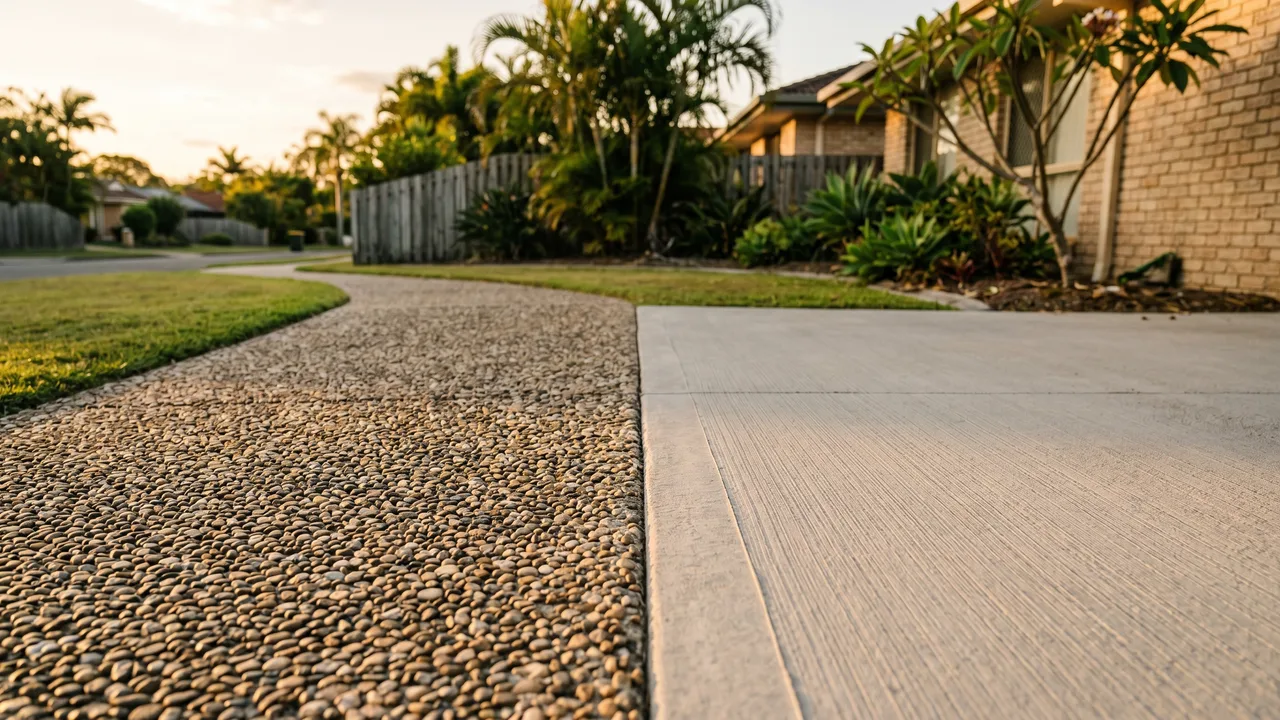
Plain concrete (sometimes called "broom finish" or "steel-trowel finish" depending on how the surface is worked) is concrete left with its grey cement-paste face showing. After the pour, the finisher either drags a broom across it for texture or trowels it smooth. It is the same mix underneath; the difference is only at the surface.
Exposed aggregate concrete uses the same structural mix, but the top layer of cement paste is washed or brushed away while the concrete is still green. This reveals the coarse aggregate — usually a blend of crushed stone and natural river pebbles — embedded just below. In Brisbane, you will often see local materials like basalt, river pebble or quartz used in the blend, sometimes with added colour.
Both finishes start from the same base pour and the same reinforcement. The aggregate option adds a step, a different blend choice, and typically a higher price.
How Brisbane's Climate Affects the Decision
Brisbane summers are humid and wet. Winters are dry but can drop to single digits overnight in western suburbs, and the Inner East suburbs like Morningside, Norman Park and Hawthorne get warm breezes off the river rather than harsh frosts. Neither finish will crack purely from freeze-thaw the way they might in southern states, but Brisbane has its own stressors.

UV exposure is significant. Plain grey concrete bleaches and looks washed out faster than exposed aggregate, which holds its character because the colour comes from the stone rather than a surface pigment.
Organic debris is the bigger practical issue. Jacaranda flowers, poinciana pods, fig leaves, and Queensland's general tree canopy drop a lot of matter. On a light grey broom-finish driveway, the tannin staining from wet leaves is obvious and hard to shift. The mottled texture and colouring of exposed aggregate does a much better job of disguising this between cleans.
Rain runoff and slip resistance also matter. A broom-finish concrete path can become slippery when wet if the surface is too smooth. Exposed aggregate is inherently non-slip because the protruding pebbles break up the water film. This is why we default to exposed aggregate for pool surrounds in Brisbane backyards. The Workplace Health and Safety guidelines around wet areas generally require a minimum slip resistance rating, and exposed aggregate typically meets that requirement without needing an added sealer or coating.
Cost: What You Are Actually Paying the Difference For
The price gap between the two finishes is real, but it is not as large as some people expect. As a rule of thumb, exposed aggregate typically adds $15-$40 per square metre over a standard broom finish, depending on the aggregate blend chosen.
On a typical suburban driveway of around 50 square metres, that might mean the difference between a $4,500 job and a $6,000 job. On a 15-square-metre alfresco pad, the gap might only be $300-$500. The percentage difference looks large, the dollar difference is sometimes modest.
Where the cost gap matters most is on large shed slabs or utility pours. A 10x6 metre garage slab at Murarrie or Tingalpa is a structural floor; it needs to be flat, level, and strong. Spending extra on an exposed finish that will mostly sit under a car or store boxes is hard to justify. Plain broom finish makes more sense there, and that is what we usually quote for those jobs.
For driveways, paths, and entertaining areas on a character block in Balmoral, Hawthorne or Bulimba, the aggregate finish tends to hold its value better and complements the existing streetscape more naturally.
Maintenance: Honest Trade-Offs
Neither concrete finish is maintenance-free. Here is what each actually requires.

Plain broom finish:
- Pressure washing keeps it clean
- Staining from leaves, oil and rust can be stubborn on light surfaces
- Re-sealing every 3-5 years helps, though many homeowners skip this
- Easier to grind and re-coat if you later want to change the surface
Exposed aggregate:
- Pressure washing is still the main cleaning method
- Dirt settles into the voids between pebbles but is less visible than on a flat grey surface
- Sealing is more important because the exposed stone can absorb oil and moisture at the aggregate-paste boundary
- Typically sealed on installation and re-sealed every 2-4 years; a quality penetrating sealer costs roughly $50-$90 for a driveway-sized area if you do it yourself
- Harder to patch invisibly if a section cracks; matching the original blend and wash depth is difficult years later
On blocks with large trees overhanging the driveway (very common in Hawthorne and Norman Park), the maintenance story for exposed aggregate is genuinely better. The mottled look absorbs visual dirt. On a plain finish, that same block looks like it needs hosing down every week.
Matching the Finish to the Block and the House
The Inner East suburbs have a mix of original Queenslander and post-war character homes alongside newer infill builds. The finish you choose should sit comfortably with the house.
For a Queenslander with a timber deck, weatherboard cladding and a garden path, a warm-toned exposed aggregate (river pebble blend with a reddish basalt component, for example) feels deliberate and considered. A plain grey slab in the same setting can look like a temporary fix.
For a contemporary brick or rendered home in Cannon Hill or Murarrie, either finish works. A smooth steel-trowel finish with saw-cut control joints looks intentional and modern. A charcoal or black aggregate blend also works well in that setting.
For pool surrounds across all the suburbs we cover, exposed aggregate with a fine-to-medium aggregate blend is almost always the right call. It is practical (slip resistance), it looks better wet, and it ages more gracefully than plain concrete, which can develop a grey, institutional look around a pool over time.
For retaining wall footings and base pours, the finish question is irrelevant. Those pours are structural and buried or hidden; plain concrete every time.
A Closing Recommendation
If your main surface is a driveway, path, alfresco area or pool surround in the Inner East, exposed aggregate will serve you better over a ten-year span. The extra upfront cost is real but is typically justified by better slip resistance, better stain resistance, and better visual longevity in Brisbane's conditions.
If you are pouring a shed slab, garage floor, or any purely utilitarian surface, plain broom finish is the sensible choice. Spend the saving elsewhere.
If you are genuinely undecided, a split approach works. Plain concrete for the structural slab, exposed aggregate for the pathway and entertaining area. We do this regularly in Morningside and Balmoral where a garage slab and an alfresco extension are part of the same project.
The most useful thing you can do before calling anyone is to look at driveways on your street and the surrounding blocks after rain. Which ones look tired and stained? Which ones still look clean? That observation will tell you more about the right choice for your suburb than any brochure.
If you want to talk through a specific job with someone who works in these streets regularly, give us a call. We can usually give a ballpark over the phone once we know the area and the approximate size.
Quick answers