Concreting guide
How long should a concrete driveway or slab last in Brisbane conditions?
How Long Should a Concrete Driveway or Slab Last in Brisbane Conditions?
A well-poured concrete driveway or slab in Brisbane should last 25 to 40 years under normal residential use. That range is wide for a reason. Brisbane's climate, the quality of the original pour, and how well you maintain the surface all push that number up or down considerably.
If you're weighing up whether to repair or replace an existing slab, or you're planning a new pour and want to know what you're buying into, this article walks through the main factors honestly.
What Brisbane's Climate Actually Does to Concrete
Concrete is tough, but it's not immune to weather. Brisbane sits in a subtropical zone, and that creates a specific set of stresses that differ from, say, Melbourne or Sydney.

The biggest factor here is the heat-and-wet cycle. Brisbane summers bring intense heat followed by heavy rainfall, sometimes within hours of each other. Concrete expands in heat and contracts when it cools or gets wet. Over years and years, that repeated movement works on any weaknesses in the slab. Fine surface crazing is common after a decade or so in older pours, though it's mostly cosmetic if the slab was properly reinforced and sealed.
UV exposure is genuinely punishing here. Bare concrete that isn't sealed will bleach, and more importantly, the surface layer can gradually become more porous. A porous surface lets water in, and that's where deeper problems start.
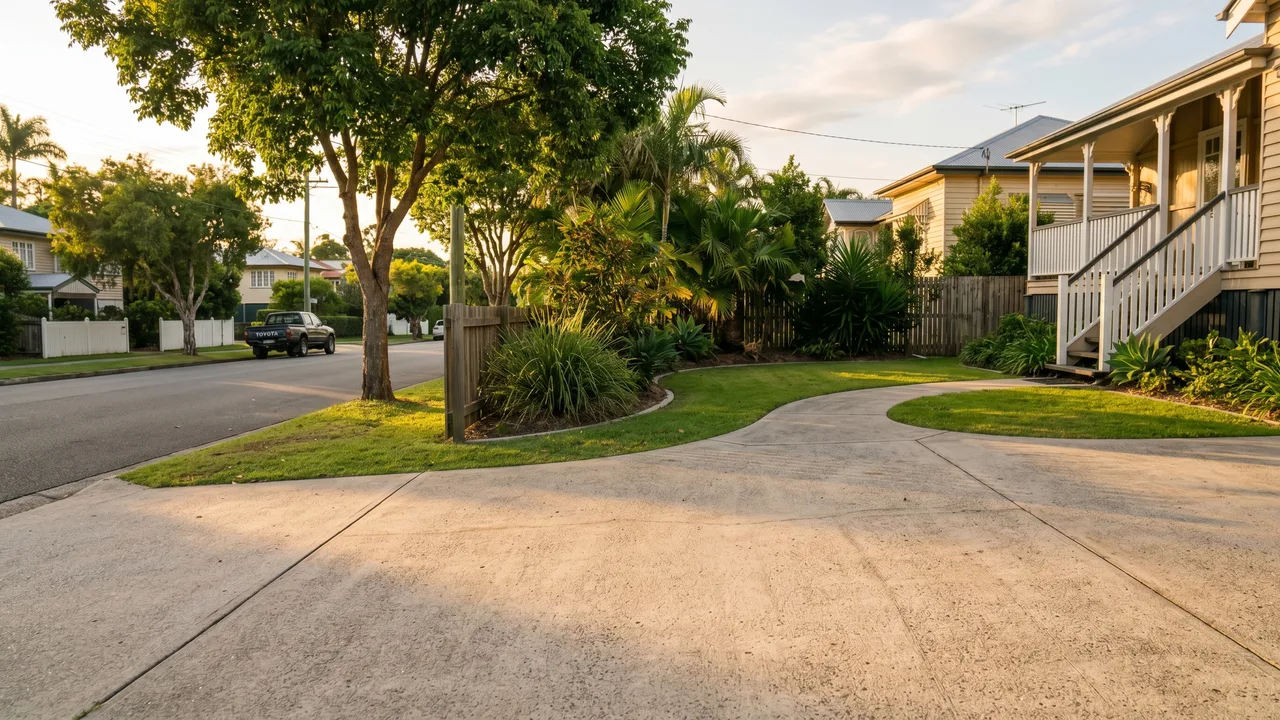
In the Inner East suburbs like Hawthorne, Bulimba, and Balmoral, large street trees are part of the appeal. Jacarandas, figs, and poinciana are beautiful, but their root systems are well known for travelling under slabs and lifting sections over 10 to 15 years. This isn't a concrete failure exactly, it's just physics. A properly installed slab with adequate thickness and reinforcement will resist root pressure longer, but no pour is completely immune if a big root decides to go underneath it.
The Pour Itself: Where Lifespan Is Won or Lost
The honest answer to "how long will my slab last" starts with what went into the ground on day one.
Concrete mix strength matters more than most homeowners realise. For a standard residential driveway in Brisbane, a 25 MPa (megapascal) mix is generally the minimum, with 32 MPa used for heavier-use applications like commercial entries or slabs that will carry a boat or caravan regularly. A mix that was watered down on-site to make it easier to work with will cure weaker and crack sooner.
Slab thickness is the other major variable. Typically, a residential driveway slab in Brisbane is poured at 100 mm. For areas that will carry heavier loads or where the subgrade is softer (which is common on Brisbane's hilly terrain in places like Norman Park and Morningside), 125 mm is worth the extra cost. The difference in concrete volume is modest; the difference in long-term performance can be significant.
Reinforcement is where corners get cut most often. Steel reinforcing mesh (SL72 or SL82 mesh is common in residential work) helps hold the slab together if cracking starts. Without it, a crack from root movement or subsidence tends to spread. With it, the slab often stays functionally sound even after cracking begins.
Curing time and conditions round it out. Concrete needs time to reach its design strength, typically 28 days for a full cure. Pouring in extreme heat without shade cloth or curing compound, or in heavy rain, can compromise the surface layer early.
Maintenance: The Gap Between 25 Years and 40 Years
Most of the difference between a slab that limps to 20 years and one that's still solid at 35 comes down to maintenance decisions along the way.

Sealing is the single highest-return maintenance task. A penetrating concrete sealer applied every five to seven years keeps the surface layer from becoming porous. Once water gets in freely, you're on a faster timeline. Sealed driveways also resist oil stains and are far easier to clean. A decent sealer costs a few hundred dollars and a half-day of your time, or you can have it professionally applied. Either way, it pays for itself in extended slab life.
Crack management is the second big one. Small shrinkage cracks in the first year or two of a new pour are normal and usually superficial. Left alone, they're often fine. But an expanding crack that lets water down to the subgrade is worth addressing early. Polyurethane crack filler or a call to a concreter to assess whether it's structural will save you money compared to eventual replacement.
Drainage around the slab matters too. If water is pooling against or under the slab consistently, the subgrade softens and the slab loses support. Brisbane's storm events can shift a lot of water quickly, so checking that your driveway drains away from the house and doesn't pond is worth doing after major rain events.
When to Repair vs. When to Replace
This is genuinely a judgement call, and it depends on what's happening with the slab.
Signs that repair is reasonable:
- Surface crazing with no depth (cosmetic)
- Isolated cracks less than 3 mm wide that aren't growing
- Minor edge chipping or spalling near the kerb
- Surface staining or discolouration
Signs that replacement is the more sensible option:
- Cracking that's widened, shifted vertically (one side higher than the other), or is spreading across the whole slab
- Sections that rock underfoot, indicating loss of subgrade support
- Concrete that's delaminating (top layer flaking off in sheets)
- Root damage that's lifted sections by more than 20 to 30 mm
A replacement driveway pour for a standard suburban block in the Inner East typically costs somewhere between $3,500 and $8,000, depending on size, access, and what's required for demolition and disposal of the old slab. If repairs are running past roughly 40 to 50 per cent of that figure, replacement usually makes more financial sense. That's a rule of thumb, not a formula, but it's a useful way to frame the decision.
Specific Considerations for Inner East Brisbane Blocks
The Inner East suburbs we cover (Morningside, Norman Park, Hawthorne, Bulimba, Balmoral, Cannon Hill, Murarrie, and Tingalpa) share some characteristics worth knowing.
Many blocks are on sloped ground. Any pour on a slope needs proper formwork, good compaction of the subgrade, and attention to drainage. Sloped sites also mean water can pool on lower areas of a slab if the fall isn't designed correctly.
Older properties in Hawthorne, Bulimba, and Norman Park often have pre-existing concrete from the 1970s or 1980s. If you're assessing a slab from that era, it's worth knowing that reinforcing mesh wasn't always used consistently in that period, and the concrete mix standards were lower. A 40-year-old unreinforced slab that's still serviceable is actually doing well, but it's living on borrowed time.
Soil types across the Inner East vary. Some areas have reactive clay, which expands when wet and contracts when dry. This seasonal movement puts ongoing stress on slabs that aren't adequately thick or reinforced. If you're on a block with reactive clay and your driveway has been lifting and settling noticeably between wet and dry seasons, that's the likely cause.
What a Realistic Lifespan Expectation Looks Like
To put it plainly: a properly poured, reinforced, sealed, and maintained concrete slab in Brisbane's Inner East should comfortably reach 30 years before any major intervention is needed. Under good conditions with diligent maintenance, 40 years is achievable. Poorly poured slabs, or slabs that are never sealed and have active drainage problems, can show serious deterioration within 10 to 15 years.
The variables you control are maintenance and who you choose to do the original work. The variables you don't control are tree roots, soil type, and the weather. Understanding both sets helps you make better decisions rather than being surprised when a slab underperforms.
If you've got an existing slab that's causing concern, or you're planning a new driveway, pathway, or garage slab and want to talk through what's appropriate for your block, we're happy to come out and have a look. No obligation; just a conversation about what you're working with.
Quick answers