Concreting guide
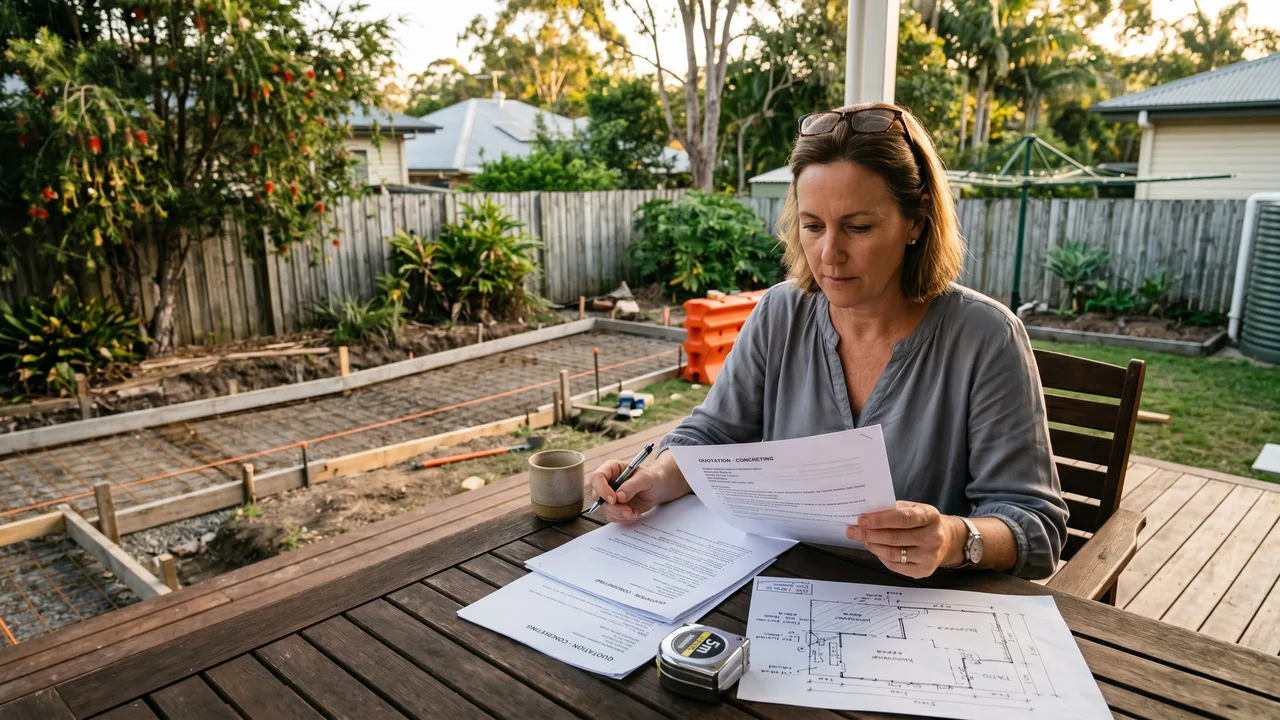
You have got three concreting quotes. How do you know which one is actually comparable?
Three quotes are sitting in front of you. The problem is they probably aren't quoting the same job.
That's the short answer. Concrete quotes vary so much — sometimes by thousands of dollars — not because contractors are dishonest, but because they've made different assumptions about your site, your finish, your base preparation and your concrete mix. Before you can pick the right quote, you need to make sure you're actually comparing the same thing.
Here's how to pull them apart.
What the Square Metre Rate Isn't Telling You
Most quotes you'll get in and around Morningside, Norman Park and Bulimba will lead with a price per square metre. It sounds simple. It isn't.

That rate can mean almost anything. One contractor might be pricing plain broom-finish concrete on a flat block with easy vehicle access. Another might be pricing an exposed aggregate finish with a coloured oxide, two layers of compacted roadbase, edge forms and a sealer coat. Those are two very different jobs, and both quotes might say "$85 per m²".
When you're reading a quote, ask yourself: what is that rate actually covering? At minimum, a useful quote should break down:
- Site preparation (does it include excavation? If so, how deep?)
- Base material (roadbase, sand, or straight onto existing soil?)
- Reinforcement (mesh, bar, or none?)
- Concrete grade (20 MPa, 25 MPa, 32 MPa?)
- Finish type (broom, exposed aggregate, honed, stamped?)
- Sealer (included or a separate line item?)
- Formwork and edge forming
- Disposal of spoil if excavation is involved
If a quote doesn't specify most of these, it's not really a quote yet. It's a ballpark.
Base Preparation: Where Cheap Quotes Save Money They Shouldn't
This is the single biggest variable in concrete pricing, and it's almost invisible to the eye once the slab is poured.
A driveway or slab sitting on properly compacted roadbase will outlast one sitting on loose fill or bare soil by a significant margin. In most Inner East Brisbane jobs, you'd typically expect at least 100mm of compacted base under a driveway, and deeper preparation on sites with clay-heavy soil, which is common across Morningside, Cannon Hill and parts of Tingalpa.
Brisbane clay expands and contracts with moisture. If the base isn't right, the concrete moves with it. You get cracking, edges lifting, slabs rocking. Fixing it later costs more than doing it properly the first time.
When you compare quotes, ask each contractor specifically: what are you putting under the concrete, and how will you compact it? If one quote is $1,500 cheaper than the others and the answer is "nothing, we'll pour on what's there," that's where the saving is coming from.
Concrete Strength and Reinforcement: What the Spec Should Say
Not all concrete is the same. The grade (measured in megapascals, or MPa) tells you the compressive strength. For most residential work in Brisbane:

- Footpaths and light-use slabs: 20 MPa is typically sufficient
- Driveways and garage slabs: 25 MPa is a reasonable minimum; 32 MPa is better for heavier vehicle loads
- Pool surrounds and alfresco areas: 25-32 MPa depending on the finish
Reinforcement matters too. Steel mesh (usually referred to as SL72 or SL82) is standard for slabs. Some jobs warrant steel bar (rebar) instead of or in addition to mesh, particularly shed slabs or retaining wall footings on sloped blocks, which are common in Hawthorne and Balmoral where block grades are noticeable.
Fibre reinforcement (polypropylene or steel fibre added to the mix) is sometimes offered as an alternative or supplement. It reduces plastic shrinkage cracking during the pour but it doesn't replace structural steel for load-bearing applications. If a quote mentions fibre, ask whether it's replacing the mesh or complementing it.
A quote that doesn't mention concrete grade or reinforcement type is leaving a lot of room for interpretation.
Site Access and Inner East Block Realities
If you're in Murarrie, Tingalpa or Cannon Hill, a concrete truck probably has a straight run to your property. In Hawthorne, Balmoral or Norman Park, your block might be on a narrow street, behind a steep frontage or set back from a lane with a 90-degree turn.
Difficult access means the concrete can't be poured directly from the truck. It has to be pumped. Pumping typically adds $600 to $1,200 or more to a job, depending on distance and volume. Some contractors include this in their quote; others don't until the truck arrives and the problem becomes obvious.
Ask each contractor: have you seen my block, or are you quoting off the address? Have you accounted for pump hire if the truck can't reach? A contractor who's physically visited the site before quoting is always going to be more accurate than one working off a Google Maps screenshot.
Older Queenslander-era blocks also sometimes have underground obstructions, old service lines in unexpected positions, or previous concrete work that needs to be broken up and removed. Confirm whether demolition and removal of existing concrete is included if that applies to you.
Finish, Sealer and What Happens After the Pour
The finish affects both the look and the long-term performance of your concrete, and it's often where quotes quietly diverge.
A plain broom finish is the most straightforward and usually the cheapest. It's practical for driveways and shed slabs. Exposed aggregate costs more (the stone needs to be seeded or the surface treated after the pour) but gives a texture that wears well and suits Brisbane outdoor areas. Honed concrete involves grinding the surface after curing and is typically the most expensive option.
Sealing is worth asking about specifically. A quality penetrating or surface sealer protects against staining and moisture and is worth doing, particularly for pool surrounds and alfresco areas. Some quotes include it; many don't. If you're comparing a quote that includes sealing against one that doesn't, you need to add roughly $8 to $15 per square metre to the cheaper quote to get a like-for-like figure (though prices vary and you should confirm with each contractor).
Curing time and the contractor's responsibility during that window matters too. Ask: what's the process after the pour? Who's responsible if the finish is damaged before it cures?
How to Actually Line Up the Three Quotes Side by Side
Once you've gathered the details, a simple comparison works better than comparing totals.
Write out a column for each contractor and a row for each variable: site inspection done (yes/no), excavation depth, base material and compaction, reinforcement type, concrete grade, finish, sealer included, pump hire included, spoil disposal included, payment terms, and start date.
Fill it in as best you can from the quotes themselves, then follow up with each contractor on the gaps.
You'll usually find that one quote gets clearer fast. The contractor who visited the site, specified the concrete grade, called out the reinforcement type and acknowledged the access challenge is probably the one who knows what they're actually doing. That's not always the most expensive quote. Sometimes it is. But it's the most honest one.
Price matters, obviously. A job in our typical range of $1,500 to $15,000 is a real spend for most households. But a $700 saving on a driveway quote that's left the base preparation vague can easily become a $3,000 repair job in five years.
A Practical Final Step Before You Decide
Ask each contractor one direct question: "If something in your quote turns out to be more complicated on the day, how do you handle that?"
How they answer tells you a lot. A good contractor will explain their variation process clearly, reference a specific scenario, and not seem caught off guard by the question. One who gives a vague "we'll work it out" is leaving you exposed.
After that, it's your call. You've got the information. You don't need pressure to make a good decision.
If you're getting quotes for work in Morningside, Norman Park, Bulimba, Hawthorne, Balmoral, Cannon Hill, Murarrie or Tingalpa and want a site-specific quote that spells all of this out, we're happy to take a look.
Quick answers