Concreting guide
Sloped blocks make concreting harder. Here is what that means for Inner East homeowners.
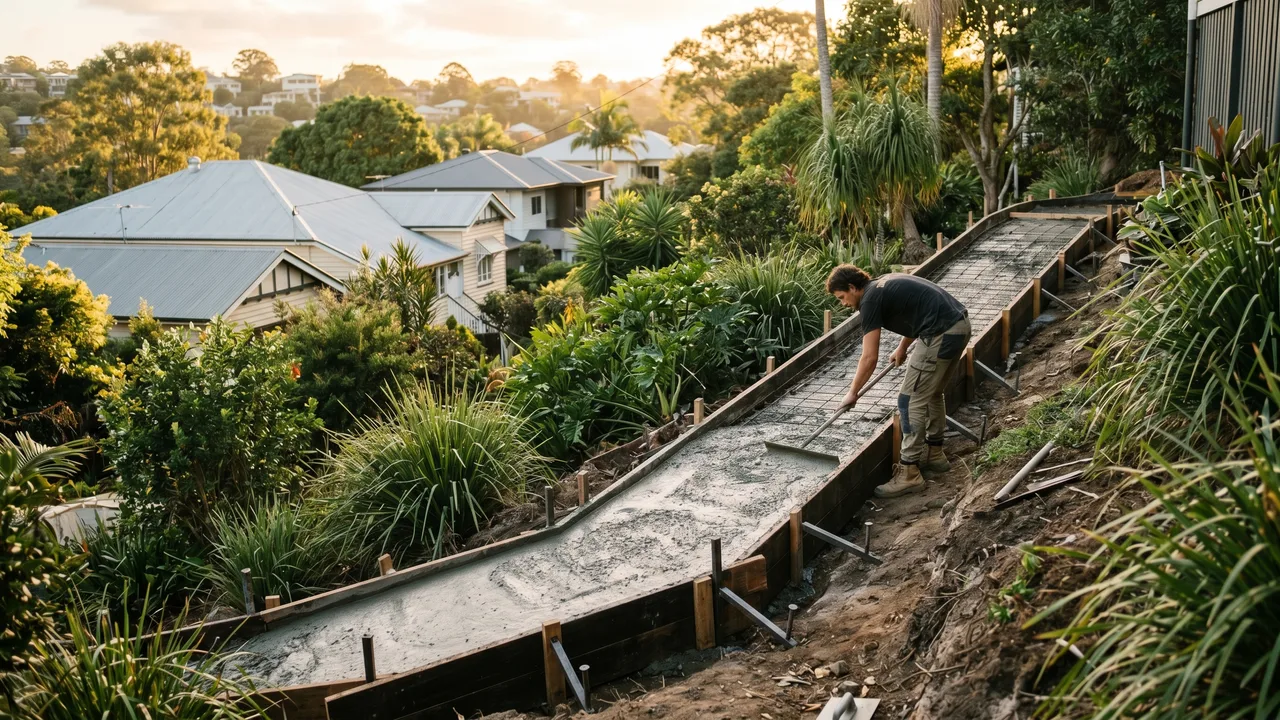
Sloped blocks make concreting harder. Yes, genuinely harder, and more expensive. If your Inner East Brisbane home sits on a hill, a ridgeline, or even a gentle cross-fall, every concrete job on your property carries extra steps that a flat suburban block simply doesn't need.
Here's what that actually means for your budget, your timeline, and the decisions you'll need to make.
Why Slope Changes Everything About a Concrete Pour
Concrete is liquid when it goes down. That's the whole point. But liquid finds its own level, and on a sloped block, "its own level" is the bottom of your yard, not the finished surface you paid for.
To hold wet concrete in place while it sets, a concreter needs formwork: timber or steel shuttering that frames the pour and holds it at the right height and profile. On flat ground, formwork is straightforward. On a slope, it becomes a three-dimensional puzzle. The frames need to step down with the terrain, the concrete depth varies across the pour, and the whole setup takes longer to build and strip back.
Beyond formwork, there's the issue of reinforcement. A flat driveway slab might need a single layer of F72 steel mesh and a standard 100 mm depth. A sloped driveway, particularly one with a change in level over its run, typically needs deeper sections, additional reo bar, and sometimes a thickened edge beam to stop the downhill edge from cracking over time under vehicle loads. That's more steel, more concrete, more labour.
What the Inner East Terrain Actually Looks Like
The suburbs we work across, Norman Park, Hawthorne, Bulimba, Balmoral, Morningside, Cannon Hill, Murarrie, and Tingalpa, aren't uniform. Parts of Bulimba and Murarrie are relatively flat, sitting close to the river floodplain. But Norman Park, Balmoral, and Hawthorne in particular are ridge and gully country. Streets like those running off the Norman Park escarpment, or the hillside blocks above Hawthorne Road, can have natural falls of three, four, even six metres across a standard 600 sqm block.

Many of these properties are older Queenslanders, which were deliberately built on stumps to follow the slope rather than fight it. That worked for a timber house. It creates real challenges the moment you want a concrete driveway from the street to a garage under the house, or a level entertaining slab in a backyard that drops away sharply at the back fence.
The good news is that Inner East soil profiles, while variable, are generally workable. You're often dealing with a clay base with reasonable bearing capacity once the topsoil is stripped. The slope is the complication, not typically the ground itself.
The Three Jobs Where Slope Adds the Most Cost
Not every concrete job is equally affected. Here's an honest breakdown.
Driveways are where slope bites hardest. A driveway that descends steeply from the street to an under-house garage might need a gradient of 1:4 or steeper in parts. At that pitch, the surface finish matters enormously for vehicle traction. A standard broom finish may not be enough; exposed aggregate or a deep-broom crosshatch finish gives tyres something to grip. You'll also be looking at additional drainage channels at the base to capture run-off before it enters the garage or hits the house stumps.
Shed and garage slabs on sloped blocks often require cut-and-fill excavation before a level slab can be poured. The cut side needs to be retained (soil doesn't stay vertical on its own), and the fill side needs compaction and, in most cases, a thickened slab edge to distribute load over that engineered fill. This is where retaining wall footings become part of the concreting conversation, not a separate afterthought.
Alfresco and entertaining areas on rear yards are the job where homeowners most often underestimate what's involved. A backyard that drops 1.5 metres over five metres of run needs either a stepped slab, a retained platform, or a combination of both. Stepped slabs are functional but limit furniture placement. A retained platform looks better but requires a proper footing pour for the retaining structure first, then a separate slab pour on top.
Drainage: The Problem That Shows Up Six Months Later
This is where many sloped-block concrete jobs go wrong, not during the pour, but after the first heavy Brisbane summer rain.

Water follows a concrete surface very efficiently. If the drainage is designed well, that water goes exactly where you want it: to a drain, to a soakage area, away from the house. If it's designed poorly, or not designed at all, it concentrates and runs somewhere inconvenient. That might mean pooling against your house slab, undermining a retaining wall footing, or sheeting across the footpath to your neighbour's property.
On a sloped Inner East block, a concrete job should always include a drainage plan. That doesn't necessarily mean expensive ACO channel drains everywhere. Sometimes a simple cross-fall on the concrete surface of 1-2%, combined with a single strip drain at the low edge, handles it neatly. But it needs to be thought through at the design stage, not retrofitted after the concrete is down.
Ask your concreter what happens to the water. If they don't have a clear answer, that's a problem worth addressing before the pour.
Cost Expectations on a Sloped Block
Flat-block concrete pricing gives you a starting point, but it's genuinely not a reliable guide for sloped work. Here's a rough sense of the premium involved.
A straightforward flat driveway in this area might come in around $120-$160 per square metre. A sloped driveway with significant grade changes, extra formwork, a drainage channel, and a deeper reinforced section can reasonably be $180-$240 per square metre, sometimes more if access is tight and a concrete pump is needed.
For a sloped backyard entertaining slab, the earthworks and any retaining footing pours often cost as much as the slab itself. A $5,000 slab job on flat ground might be a $9,000-$12,000 job on a block that needs a retained platform. That's not a markup; it's genuinely more work, more materials, and more engineering judgement.
The honest trade-off: if budget is tight, a smaller, well-executed slab on a properly prepared level area is a better outcome than a large slab that cuts corners on subgrade preparation or drainage. Size down and do it right.
Getting a Quote That's Actually Useful
A quote for concreting on a sloped block should be more detailed than one for flat work. If you receive a single-line quote with just a price and a square metre rate, push back and ask what's included.
Specifically, check whether the quote covers:
- Formwork complexity (stepped, battered, or multi-level)
- Any excavation or cut-and-fill required
- Reinforcement specification (mesh grade, thickness, additional reo bar)
- Concrete mix strength (typically 25 MPa or 32 MPa for driveways; higher for retained footings)
- Drainage provision (what type, where it discharges)
- Access requirements (can a truck reach the pour, or does a pump need to be factored in)
We visit sloped blocks before quoting. You can't price this work accurately from a photo or a phone conversation, and anyone who tells you otherwise is guessing.
A Practical Note Before You Commit
If you're planning concrete work on a sloped Inner East block, get the site visit done before you commit to anything. Even if you're comparing quotes, the first step is understanding what the slope actually requires, not what you'd like it to cost.
For most jobs in Norman Park, Balmoral, Hawthorne, and the hillier parts of Morningside, the concrete itself is straightforward. It's the preparation, the drainage, and the formwork where the complexity lives. Get that part right and the concrete will perform well for decades. Rush it, and you'll be looking at cracking, pooling, or movement within a few years.
If you'd like us to take a look at your block and give you an honest read on what a job actually involves, that's exactly the kind of conversation we're here for.
Quick answers