Concreting guide
How do you know when a concrete driveway actually needs replacing?
How Do You Actually Know It's Time to Replace Your Concrete Driveway?
Most concrete driveways don't fail overnight. The honest answer is that replacement becomes the right call when the cost and effort of ongoing repairs starts to outweigh what a fresh pour would cost you, or when the damage is structural rather than cosmetic.
That line is different for every driveway. What follows is a practical way to read what your slab is telling you.
Surface Damage vs Structural Damage: The Distinction That Matters Most
This is the first question worth asking, because surface damage and structural damage look similar but have very different implications.

Surface damage includes things like spalling (where the top layer flakes off), light crazing (a web of hairline cracks across the surface), minor pitting, and staining. These are mostly cosmetic. They don't mean the slab is failing. In many cases you can live with them, or address them with a surface grind and reseal.
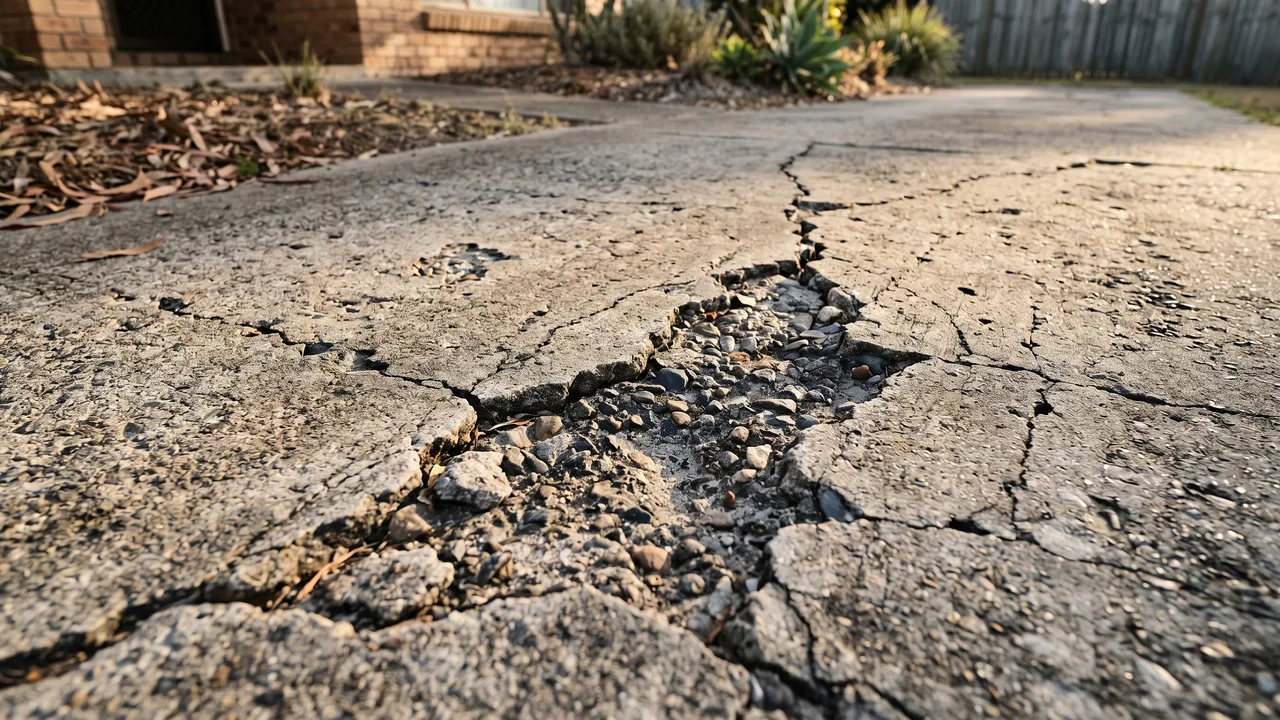
Structural damage is a different conversation. It includes:
- Cracks wider than about 5-6 mm, especially ones that are still growing
- Sections of the slab that have shifted vertically relative to adjacent sections (called differential settlement)
- Slabs that flex or feel hollow underfoot, suggesting the base material beneath has washed out or compacted unevenly
- Any section where water is pooling toward the house rather than away from it
If you're seeing structural damage, patching usually just delays the inevitable. The underlying cause, whether it's poor compaction, tree root movement, or drainage problems, won't be fixed by filling the crack.
Cracking: When to Worry and When Not To
Cracks are the most common reason people call us, and most of the time the question isn't whether to repair or replace, but whether the crack matters at all.
Concrete cracks. It's designed to do so in a controlled way. That's what the control joints (the straight grooved lines cut into most driveways) are for. They give the slab a predetermined place to crack as it expands and contracts with Brisbane's heat cycles.
What you're looking for is whether cracks are in the right place, and whether they're stable.
A crack running along a control joint? Probably fine. A crack running diagonally across a slab panel, especially one that's wider at one end than the other? That's a sign of differential movement, and worth looking at more carefully.
In the Inner East suburbs around Morningside, Norman Park, and Hawthorne, large street trees, often poinciana, jacaranda, and fig species, are a genuine factor. Root systems from a mature street tree can lift a slab edge by 30-40 mm over a few years. If that's what's happening, replacing the slab without addressing the root situation will get you the same result in five to ten years.
Age and the Realistic Lifespan of a Concrete Driveway
A well-poured concrete driveway in Brisbane typically lasts 25 to 40 years with minimal maintenance. That range is wide because it depends heavily on what's underneath, how it was reinforced, and whether drainage has been managed.

Driveways poured before the mid-1990s may be undersized for modern vehicles. SUVs, dual-cab utes, and vans are heavier than the sedans most older slabs were designed around. If your driveway is 30-plus years old and you're seeing cracking near the edges where vehicles overhang, that's a loading and thickness problem, not just age.
It's also worth knowing that older slabs in Bulimba, Balmoral, and other established Inner East suburbs were sometimes poured at 75 mm thickness. Current residential standards typically call for 100-125 mm for a driveway carrying passenger vehicles, with steel reinforcement. An older, thinner slab that's cracking under load isn't going to be improved by surface repairs.
The Repair vs Replace Calculation
Here's a rough way to think about it. If the repairs needed would cost more than about a third of a full replacement, and the driveway is already more than 20 years old, replacement usually makes more sense over a five-to-ten year horizon.
Patch repairs on concrete typically cost somewhere in the range of $200 to $600 for a standard residential driveway section. A full driveway replacement for a typical suburban block in Morningside or Cannon Hill, say a double driveway of around 40-50 square metres, would typically sit somewhere in the $4,000 to $8,000 range depending on site access, thickness specified, and any excavation or drainage work needed.
Repairs are the right call when:
- The slab is less than 15 years old
- Damage is isolated to one area with a clear cause (a tree root that's since been dealt with, a single impact crack)
- The base is sound and draining properly
- There's no differential settlement between panels
Replacement is the better call when:
- Multiple panels are affected
- The slab is lifting near tree roots and the problem will continue
- Drainage is running toward the house (this is a safety and waterproofing issue)
- The driveway is so uneven it's becoming a trip hazard or damaging vehicles
What Brisbane's Climate Does to Concrete
Brisbane's subtropical climate is harder on concrete than most people realise. It's not the cold and freeze-thaw cycles that cause the damage you'd see in southern states. Here it's the combination of high summer UV, heavy rainfall events, and long dry spells that create expansion and contraction stress.
UV exposure breaks down sealers faster. If your driveway was sealed and hasn't been resealed in more than five years, the surface is likely unprotected, which accelerates spalling and surface erosion. A quality penetrating sealer every four to six years is genuinely worth doing for a driveway in good structural condition.
Heavy rain events, which are increasingly intense across the Brisbane basin, also matter for what's under your slab. If stormwater is channelling beneath the slab and washing out the compacted base, you can end up with voids that cause the slab to crack or sink in sections. This is more common on sloped blocks, which are prevalent across Tingalpa, Murarrie, and parts of Balmoral. Downpipe connections and surface drainage are worth checking before any new pour.
Getting an Honest Assessment
The most useful thing you can do before spending any money is to walk the driveway deliberately and look for the signs above. Bring a screwdriver or a coin. Tap on sections that look hollow or discoloured. Note where water sits after rain.
If you're genuinely unsure, ask a concretor to come out and look rather than quote immediately. A professional assessment should take 15-20 minutes and shouldn't cost you anything. A good operator will tell you honestly if the slab can be patched, because a repair job today is a return customer in five years. They should also tell you when they think replacement is the only sensible answer.
We work across Morningside, Norman Park, Hawthorne, Bulimba, Balmoral, Cannon Hill, Murarrie, and Tingalpa. If you want a no-obligation look at what you're dealing with, we're happy to come out and give you a straight assessment before you commit to anything.
Quick answers