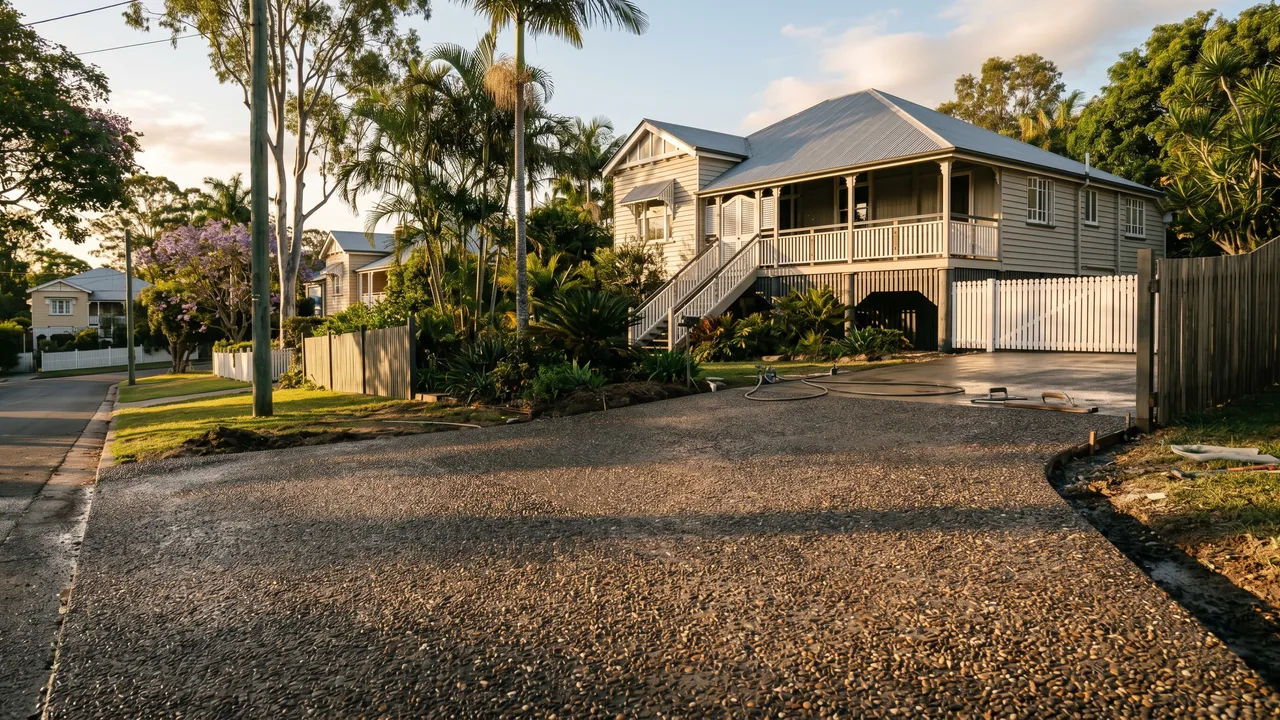
Concreting
Concrete Driveways.
Concrete Driveways in Morningside and the Inner East
A concrete driveway is one of the harder-working surfaces on your property. It takes the weight of vehicles every day, handles Brisbane's summer downpours, and sits in full view of the street. When it fails, it usually fails slowly, which means a lot of homeowners put up with a crumbling or cracked driveway for longer than they should.
We pour and replace concrete driveways for homes across Morningside, Norman Park, Hawthorne, Bulimba, Balmoral, Cannon Hill, Murarrie and Tingalpa.
What the work actually involves
A new driveway pour or replacement is a multi-step process, not just a single day of laying concrete.
For a replacement, we start by breaking out and removing the existing slab or pavers. This typically involves a jackhammer or bobcat, and the old material gets carted off site. For a new pour on bare ground, we begin with earthworks to establish a stable, level base.
From there, the process looks like this:
- Sub-base preparation. We compact the ground and bring in road base or fill where needed to create a firm, even foundation. Skipping this step is the main reason cheap driveways crack early.
- Formwork. Timber or steel forms are set to define the slab's shape, thickness and falls (the slight slope that channels rainwater away from your garage and house).
- Reinforcement. Most residential driveways in Brisbane use steel mesh (SL72 or SL82 typically), though heavier-gauge bar chairs and trench mesh are used where the ground is softer or where a heavier vehicle load is expected.
- Concrete pour. We use a readymix truck for anything beyond a very small job. Standard residential driveways in Brisbane typically use a 25 MPa or 32 MPa mix. The concrete is screeded, floated and finished to the specified texture.
- Finishing. Options include broom finish (the most common for driveways, because it gives grip), exposed aggregate, stencil, or plain smooth. Broom finish is the most practical and tends to hold up well in Brisbane's climate.
- Curing. Concrete needs time and moisture to cure properly. We apply a curing compound or keep the surface wet, depending on conditions. In Brisbane's heat, this step matters.
A standard residential driveway typically takes one to two days on site, not counting cure time.
When does a Morningside home actually need this?
The most obvious trigger is visible damage: cracking, spalling (surface flaking), subsidence where the slab has sunk, or tree root lift. Older Queenslander homes across Norman Park and Hawthorne often have driveways that are 30 or 40 years old, and those are typically well past their useful life.
Other signs it's time:
- Cracks wider than roughly 5mm, or cracks that are growing
- Edges that are crumbling or breaking away
- Water pooling near the garage or entry because the drainage falls are wrong
- A surface that's become dangerously slippery when wet
- You're rebuilding or adding a garage and need the driveway to match
There's no strict seasonal rule, but avoid pouring in the hottest part of summer if you can. Extreme heat can cause concrete to set too fast and crack. Late autumn through to early spring is generally easier to work with in Brisbane.
What does it cost?
For residential driveways across Inner East Brisbane, a rough guide is:
- Single-car driveway (around 30-45 m²): typically $3,000 to $6,000
- Double-car driveway (around 50-70 m²): typically $5,500 to $10,000
- Longer or wider approaches (kerb to garage on a deep block): can reach $12,000 to $15,000+
Several things move the price up:
- Demolition and removal of an existing slab adds cost (usually $500 to $1,500 depending on thickness and access)
- Difficult access (tight block, no room for a concrete truck, steep grade) raises both labour and pour costs
- Exposed aggregate or decorative finishes cost more than a standard broom finish
- Soft or unstable sub-soil may require deeper excavation or extra fill
- Kerb crossings on a council road typically require a separate council permit and may involve an additional fee
What's included in our quote, and what isn't?
Our quotes typically include sub-base prep, formwork, mesh reinforcement, the concrete pour, finishing and curing compound. Removal of an existing driveway is quoted separately as a line item, because the effort varies a lot depending on what's there.
What's usually extra or conditional:
- Council permits for new or modified kerb crossings (you apply for these, but we can advise)
- Root removal or major earthworks beyond standard prep
- Any drainage infrastructure beyond basic surface falls
We'll walk through the scope clearly before any work starts. If something changes on the day (unexpected ground conditions, for example), we discuss it before we proceed.
Is this the right service for your property?
A concrete driveway makes sense when you want a durable, low-maintenance surface that can handle vehicle loads for 25 to 40 years with basic upkeep. If your current driveway is structurally failed (not just cosmetically rough), replacement is usually more cost-effective than patching.
If you're unsure whether the slab can be repaired rather than replaced, we can look at it and give you an honest assessment.
A note on safety and qualifications
Concrete work involves heavy equipment, readymix deliveries to suburban streets, and formwork near boundaries and structures. We carry public liability insurance and operate under an ABN. If you have questions about compliance with Brisbane City Council requirements for kerb crossings or driveway widths, we can point you toward the relevant council guidance.
If you'd like a look at the driveway and a written quote with no obligation, give us a call. It helps to have the measurements handy, or we can take them on site.
Quick answers
Frequently asked.
How long does a concrete driveway last in Brisbane?
Do I need council approval for a new driveway in Morningside?
Can you pour a new driveway over the top of the old one?
What finish is best for a residential driveway in Brisbane?
How soon can I drive on a new concrete driveway?
What is the difference between 25 MPa and 32 MPa concrete for a driveway?
Ready to book
Quickest is by phone.
Up-front pricing on the call. Booked in one go. No site visit needed.