Concreting
Shed and Garage Slabs.
Reinforced Concrete Slabs for Sheds and Garages in Morningside
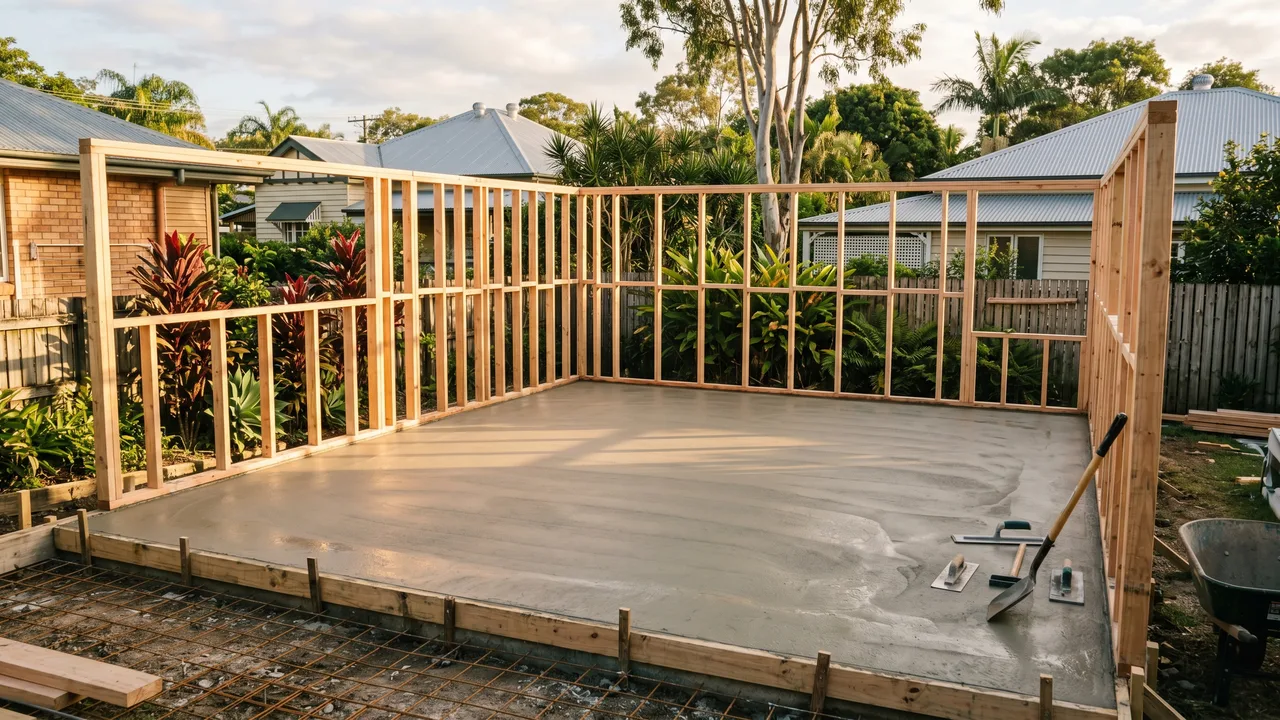
A solid slab makes the difference between a shed that works hard for decades and one that shifts, cracks, and becomes a headache. Whether you're putting up a new garage in Cannon Hill, adding a backyard workshop in Tingalpa, or replacing a crumbling old pad in Morningside, the concrete underneath is what everything else depends on.
Here's what the job actually involves and what you should know before calling anyone.
What the Work Involves
A shed or garage slab is a reinforced concrete pad, typically 100 mm thick for a standard backyard shed and 100-150 mm for a garage or workshop carrying vehicle loads. For anything heavier, like a boat on a trailer or a car hoist, thickness and reinforcement go up accordingly.
The process runs roughly like this:
- Site preparation - We clear vegetation, strip topsoil, and compact the sub-base. If the ground is soft or poorly drained (common in parts of Murarrie and Tingalpa), we bring in road base and compact it in layers before a single drop of concrete goes down.
- Formwork - Timber or steel forms are set to the correct level and fall (yes, slabs need a slight fall away from the structure so water drains off).
- Reinforcement - Steel reinforcing mesh (SL72 or SL82 typically) is placed on bar chairs so it sits in the middle of the slab depth, not on the ground. For heavier-use slabs, we use deformed bar (rebar) instead.
- Concrete pour - We use a ready-mix truck in most cases. For tight access blocks, a concrete pump or a series of barrow runs may be needed.
- Finishing - A broom or trowel finish depending on use. Workshops and sheds usually get a broom finish for grip; some clients prefer a smooth trowel finish they can seal later.
- Curing - The slab needs to cure slowly. We apply curing compound or keep it moist for the first few days, especially through Brisbane's hot dry spells.
When You Actually Need a New Slab
A few common situations we see across the Inner East suburbs:
- You're building a new shed or garage from scratch and the block has never had a slab.
- The existing concrete is badly cracked, heaving, or crumbling (surface flaking is cosmetic; structural cracks running edge to edge are a different matter).
- The old slab is too thin for what you now need. A 75 mm slab poured in the 1970s often isn't up to holding a modern SUV.
- You're converting a carport to an enclosed garage and the existing apron or path isn't a proper structural slab.
There's no fixed season for this work in Brisbane, though we'd generally avoid pouring in the peak of a heatwave if it can be helped. Extreme heat speeds up the set too fast and increases crack risk. The shoulder seasons, autumn and spring, are ideal.
What It Typically Costs in Brisbane
For a standard backyard shed slab (say 3 m x 6 m), expect to pay somewhere in the range of $1,500 to $3,500 depending on conditions. A double garage slab (typically 6 m x 6 m or 6 m x 7 m) usually sits between $3,500 and $7,000 installed.
What pushes the price up:
- Poor ground conditions requiring extra excavation or imported fill
- Difficult access (narrow side passages in Hawthorne and Balmoral terraced blocks are a common one)
- Concrete pump hire when the truck can't get close
- Thicker slab specification for heavy loads
- Edge thickening (a thickened perimeter beam integrated into the slab)
What brings it down: straightforward flat ground, good truck access, a simple rectangular shape.
What's Included in Our Quote vs What's Extra
A standard quote from us covers excavation to nominal depth, compacted road base, reinforcing mesh on chairs, ready-mix concrete at the specified strength, formwork, finishing, and curing compound.
Things that may be quoted separately or flagged as potential extras:
- Significant rock breaking or tree root removal
- Extra fill or base material if the ground level is well below finished floor height
- Concrete pump hire (we'll tell you upfront if access requires one)
- Any drainage pits or ag-pipe work around the slab perimeter
We'll tell you what's included before you sign anything.
Is a Concrete Slab Right for Your Property?
For most Brisbane suburban blocks, yes. Timber-framed shed floors exist but they require maintenance, can rot, and don't suit vehicles or heavy equipment. A concrete slab is lower maintenance once it's down.
One thing worth checking first: if your block is steeply sloped (common in parts of Norman Park and Balmoral), a slab at ground level may not be practical without significant cut and fill or a retaining structure. In that case, we'd tell you honestly rather than pour something that won't last.
Also check your council requirements. Brisbane City Council typically requires a building approval for enclosed garages and some larger sheds. The slab itself is part of that approval process. That's your job to sort with council, but we can pour to whatever specification your certifier requires.
A Note on Qualifications and Insurance
Concreting work in Queensland doesn't require a QBCC contractor licence for slabs under certain thresholds, but for any work connected to a licensed building project, you want someone who carries public liability insurance and knows what they're doing with reinforcement and drainage. Ask your concreter directly. We carry public liability cover and we're happy to talk through what we're doing and why before any work starts.
If you've got a site in Morningside, Cannon Hill, Hawthorne, Bulimba, Balmoral, Norman Park, Murarrie, or Tingalpa, get in touch with some basic dimensions and we can give you a straight ballpark before committing to a site visit.
Quick answers
Frequently asked.
How thick should a concrete slab be for a backyard shed in Brisbane?
Do I need council approval for a shed or garage slab in Brisbane?
How long does a shed or garage slab take to complete?
What causes concrete slabs to crack, and can it be prevented?
Can you pour a slab on a sloped block in suburbs like Norman Park or Balmoral?
What finish is best for a workshop or garage slab?
Ready to book
Quickest is by phone.
Up-front pricing on the call. Booked in one go. No site visit needed.